
Quantum Lifeline, Capitol Breakthrough, Miner Pivot, Options Check
From a new PACTs proposal to protect Satoshi-era coins to a bipartisan deal on stablecoin yields, we cover the moves that matter. Plus, Riot’s data-center revenue pops, Bitcoin difficulty eases, and options price a cautious May.
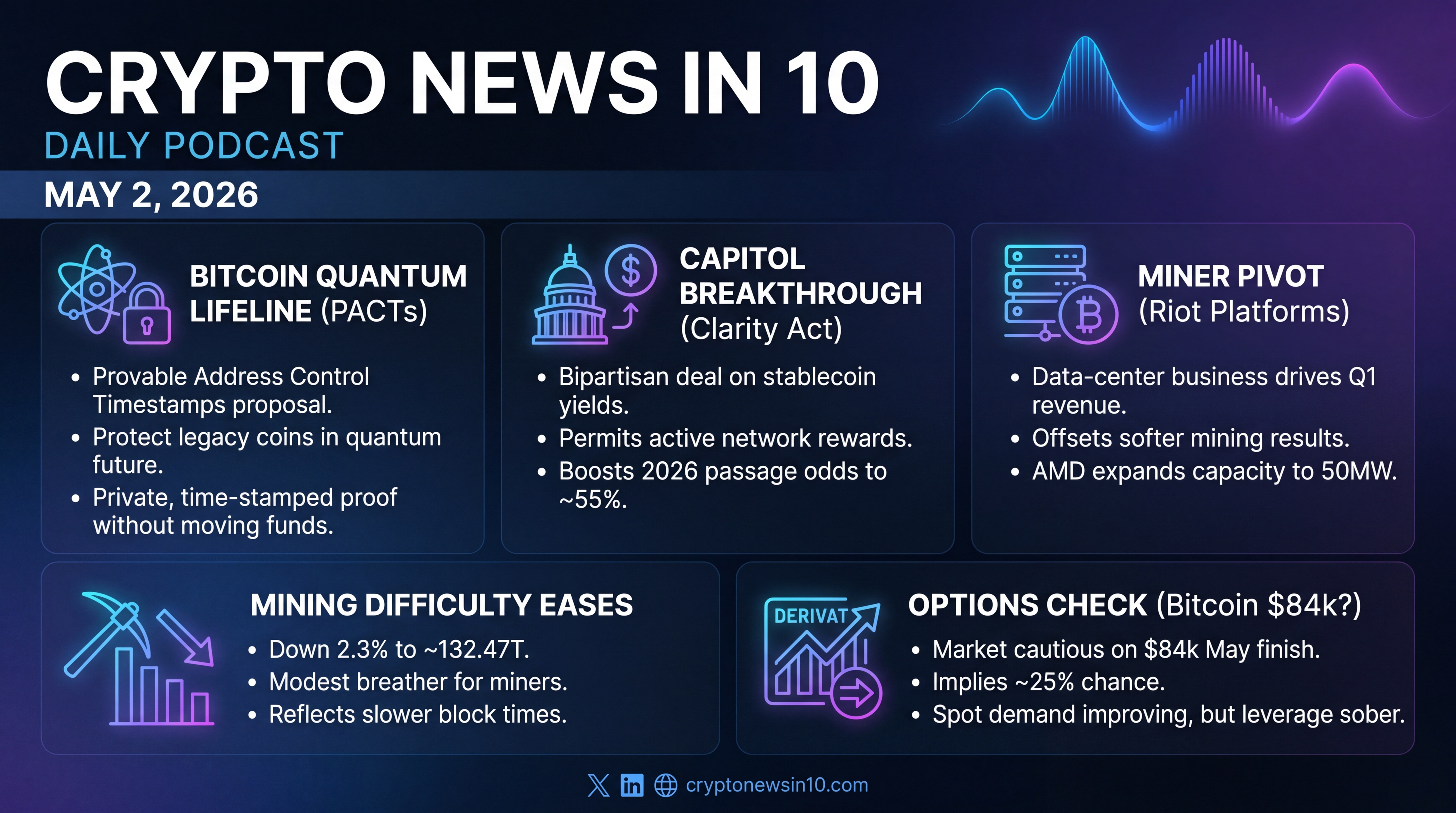
Episode Infographic
Show Notes
Welcome to our Crypto news in 10, a daily podcast bringing you the latest news about crypto in under 10 minutes.
It’s Saturday, May 2, 2026, and today’s crypto rundown is all signal. We’ll start with a fresh technical proposal aimed at protecting Satoshi-era coins in a future quantum world... then zoom out to Washington, where a bipartisan deal on stablecoin yields may finally unjam the Clarity Act. We’ll hit corporate earnings — Riot’s data-center pivot is starting to show up in results — check in on the newly adjusted Bitcoin mining difficulty, and round it out with what options markets are really pricing for Bitcoin this month. Let’s dive in.
[BEGINNING_SPONSORS]
Story one — A quantum contingency for Bitcoin
A new idea from Paradigm’s Dan Robinson is lighting up developer chats — PACTs, short for Provable Address Control Timestamps.
The short version... holders of old, quantum-vulnerable addresses can privately generate a time-stamped proof today that they control those keys, without moving coins. If, down the road, Bitcoin adopted a soft fork rescue path, those pre-committed proofs could be used to claim funds even if quantum attacks made legacy signatures unsafe. Think of it as an escape hatch... baked into time itself.
Why this matters. The debate over freezing or migrating legacy outputs has been simmering as quantum timelines get argued in public. PACTs try to square two core Bitcoin values — property rights and future-proofing — while avoiding the market shock that could come if very old wallets started moving now.
Expect pushback and peer review — the details involve zero-knowledge proofs and how to anchor commitments on-chain without doxing private keys. But it’s a concrete proposal... arriving just as quantum risk modeling moves from theory to tabletop demos.
Story two — Capitol Hill clears a big hurdle
In D.C., the Clarity Act took a real step forward. Senators Thom Tillis and Angela Alsobrooks finalized compromise language on the thorniest issue — stablecoin rewards.
The update bars paying any form of interest or yield merely for passively holding a payment stablecoin — basically, a bank-style deposit — yet preserves rewards tied to bona fide network activity. Coinbase policy lead Faryar Shirzad cheered the move, saying it protects Americans’ ability to earn rewards for using crypto while addressing bank concerns.
Research shops now see the Senate Banking Committee eyeing a markup as soon as the week of May 11, and betting markets nudged passage odds for 2026 up to around fifty-five percent. Punchbowl News first obtained the language late Friday, with Forbes and Reuters echoing the breakthrough.
Story three — Riot’s data-center bet shows up in Q1 numbers
Riot Platforms reported 167.2 million dollars in first-quarter revenue, and here’s the eyebrow-raiser — the brand-new data-center business chipped in 33.2 million, helping offset softer mining revenue amid a higher global hash rate and lower average Bitcoin prices year over year.
Riot produced 1,473 Bitcoin in the quarter, and mining revenue came in at 111.9 million versus 142.9 million a year ago, with unit costs nudging up to roughly 44,600 dollars per coin. Management called the pivot an inflection point, highlighting that A M D doubled its contracted capacity with Riot during the quarter — from 25 to 50 megawatts — a sign that A I and high-density compute demand can smooth cyclical mining cash flows. Shares popped more than seven percent into the close after the print.
The broader theme we’re tracking... miners are increasingly monetizing power, land, and interconnects — not just block rewards. Several listed peers are retooling facilities for A I or blended workloads as margins compress post-halving and with difficulty elevated. Expect this miner-to-data-center storyline to be a recurring 2026 motif.
[MIDPOINT_SPONSORS]
Story four — Bitcoin difficulty nudges down two point three percent
Overnight, Bitcoin’s mining difficulty adjusted down two point three percent at block height 947,520 — landing near 132.47 trillion. It’s a modest easing after several choppy epochs this spring, reflecting slightly slower average block times. Multiple data tickers show the same print, with the seven-day hash rate hovering around 966 exahashes per second.
Miners get a small breather on unit economics — every terahash per second is a touch more productive — but the bigger picture remains a knife-edge balance between price, power costs, and the post-halving subsidy. If you’re modeling cash flows, pair that difficulty dip with your local power curve and curtailment profile... small changes at this scale matter. Keep an eye on the next-epoch estimates — pre-adjustment trackers had already flagged a likely downward move based on above-target block intervals.
Story five — Derivatives say... maybe, but not a moonshot
Yes, Bitcoin reclaimed the 78,000 dollar level into the weekend — but options markets are not screaming mania. On Deribit, calls expiring May 29 with an 84,000 dollar strike were pricing around 0.0136 Bitcoin today, implying roughly a twenty-five percent chance that Bitcoin finishes May above that level. The put-call skew remains tilted toward downside hedging, and the two-month futures basis looks subdued compared with the typical four to eight percent premiums you see in a healthy contango. Translation... spot demand is improving, but leverage is still cautious.
At the same time, analysts point to continued net accumulation by listed companies and a return to net inflows across U.S. spot Bitcoin ETFs in April — so even with skeptical options pricing, steady spot absorption can tighten the float. That tension between sober derivatives and improving cash buying is the dynamic to watch through May.
Quick recap... A forward-looking quantum safety valve — PACTs — could let long-dormant Bitcoin prove ownership today for a safer tomorrow. U.S. lawmakers just bridged the stablecoin-yield gap, pushing the Clarity Act toward a mid-May markup. Riot’s quarter shows why miner footprints double as A I-ready data centers. Difficulty eased two point three percent, tossing miners a small bone. And options say Bitcoin above 84,000 dollars this month isn’t the base case — even as spot interest rebuilds. That’s your Saturday snapshot... see you tomorrow.
Thanks for listening and see you tommorow!
