
Prediction ETFs Arrive, Western Union Goes On-Chain
Wall Street readies election prediction ETFs, Western Union preps a Solana-based dollar stablecoin, Japan eyes spot crypto ETFs by 2027, Tezos tests a unified EVM-Michelson layer, and TRM Labs spotlights North Korea’s outsized hack haul. Get the week’s biggest crypto movers in six minutes.
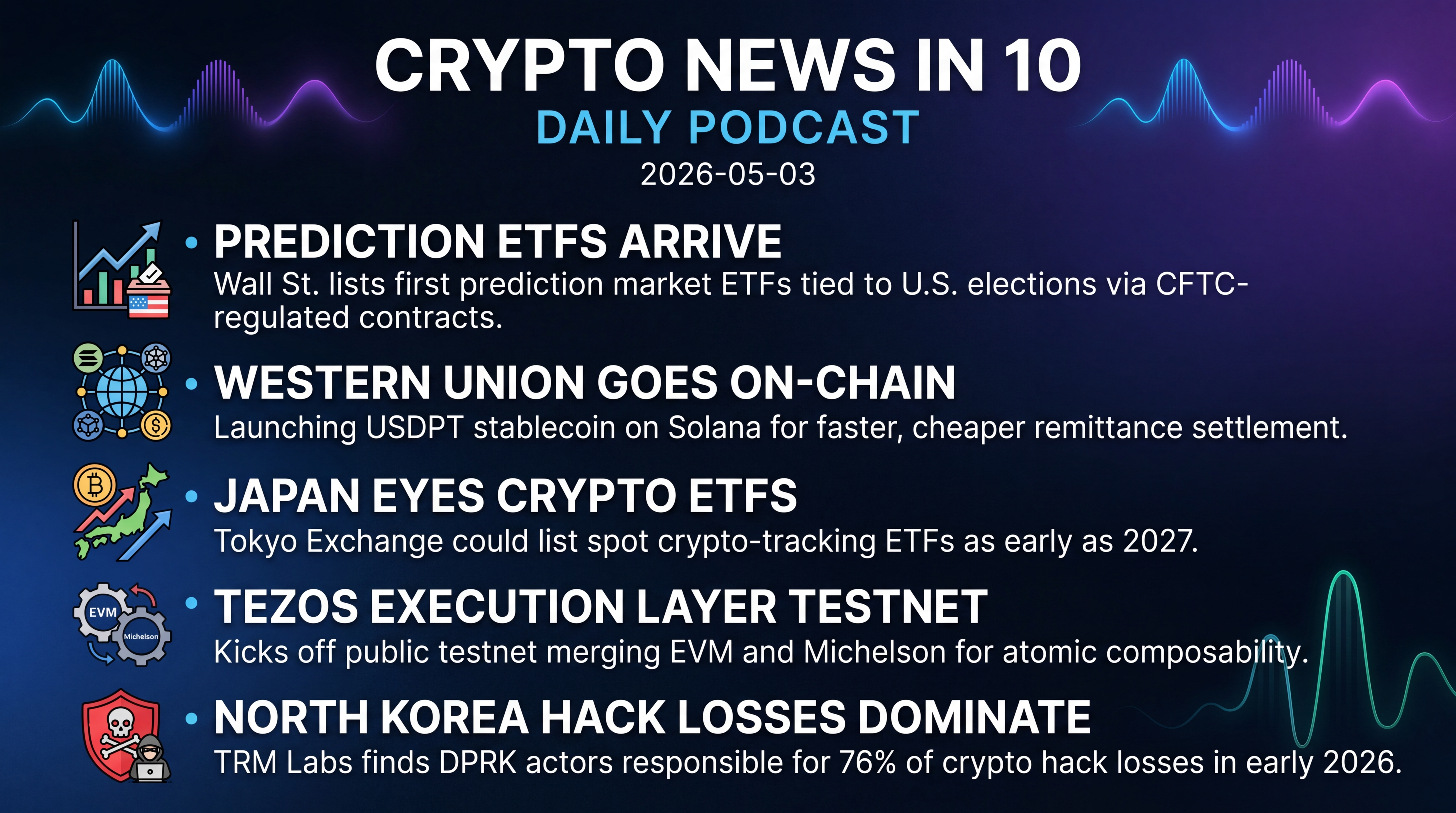
Episode Infographic
Show Notes
Welcome to our Crypto news in 10, a daily podcast bringing you the latest news about crypto in under 10 minutes.
It’s Sunday, May 3, 2026, and we’ve got a fast six-pack of developments setting up a pivotal week for crypto. On deck: Wall Street is about to list the first-ever prediction market ETFs... Western Union is preparing a dollar stablecoin launch on Solana... Japan’s main exchange operator says crypto ETFs could hit Tokyo as soon as next year... Tezos is kicking off a new execution layer testnet that merges EVM and Michelson in one place... and a sobering security brief from TRM Labs shows North Korea dominating this year’s hack losses. Let’s get you up to speed before markets open and headlines start flying.
[BEGINNING_SPONSORS]
Story one — prediction markets move from the fringes to the ETF wrapper.
Roundhill Investments has set Tuesday, May 5, as the effective date for six U.S. exchange-traded funds that mirror political prediction markets — two for the presidency, two for Senate control, and two for House control, split by party.
The products get exposure through swaps tied to CFTC-regulated binary event contracts, and the prospectus is blunt: if the targeted party loses, the fund will lose substantially all of its value.
The structure rolls forward to the next election cycle once an outcome is priced as essentially certain for five straight trading days.
Bloomberg’s James Seyffart flagged the May 5 timing after Roundhill’s post-effective amendment hit the SEC on April 29. Bitwise and GraniteShares have similar slates in the queue. If these funds ring the bell this week, they’ll bring Polymarket and Kalshi style event pricing into everyday brokerage accounts... a major milestone in the ETF wave touching almost everything.
Source: CoinMarketCap Academy.
Story two — a century-old remittance giant is going on-chain.
Western Union is in final prep to launch USDPT, a U.S. dollar-backed stablecoin issued by Anchorage Digital Bank and running on Solana. Management has guided to a May go-live, starting with back-end settlement between Western Union and its global agent network — think quicker, cheaper wholesale flows replacing chunky SWIFT legs — before consumer-facing features expand later in 2026.
For context, Anchorage is the federally chartered crypto bank responsible for minting and redeeming the token under U.S. oversight, while Solana brings high throughput and low fees. If this hits as planned, it’s a real-world test of how regulated stablecoins can compress settlement times and costs in a $700 billion-plus remittance market.
Sources: Anchorage Digital and company statements.
Story three — Japan’s window for spot crypto ETFs may open sooner than expected.
In an interview published April 30, Japan Exchange Group CEO Hiromi Yamaji said crypto-tracking ETFs could list as early as next year, contingent on legal and tax rule revisions. Asset managers have shown solid interest, and the operator of the Tokyo Stock Exchange says it’s operationally ready once the policy pieces snap into place.
For the global market, a 2027 green light in Tokyo would add a major Asia venue alongside the U.S., and broaden the investor base for spot Bitcoin — and potentially Ether — exposure.
Source: Bloomberg.
[MIDPOINT_SPONSORS]
Story four — Tezos flips the switch on a new execution era.
Tezos X, the network’s next-generation execution layer, is set to enter public testing in May, unifying EVM and Michelson smart contracts on a single shared ledger. That means, for builders and users, atomic composability across both environments — an EVM contract can call a Michelson contract and vice versa... in one transaction... no bridges, no wrapped assets.
The roadmap targets a governance vote in June to bring the layer live on mainnet, beginning with EVM — via Etherlink — plus a Michelson interface. A RISC-V migration is planned for the second half to expand supported runtimes and tighten gas predictability.
It’s a bold attempt to combine speed and composability without fracturing liquidity.
Source: Tezos Spotlight.
Story five — a stark security reality check.
According to TRM Labs, North Korea-linked actors were responsible for roughly 76 percent of all crypto hack losses in the first four months of 2026 — about 577 million dollars — despite accounting for only a sliver of total incidents. Two big blows did most of the damage: the late-April KelpDAO exploit and the April 1 attack on Drift Protocol, with investigators tying both to DPRK-affiliated groups.
The pattern underscores how a handful of sophisticated, well-resourced actors can skew annual loss totals — and it puts renewed focus on cross-chain messaging security, oracle design, and circuit breakers. For teams, the takeaway is clear: tighten privilege boundaries, validate off-chain data with redundancy, and rehearse incident playbooks.
Source: CoinMarketCap Academy summarizing TRM Labs.
Quick hits before we wrap: keep an eye on Tuesday’s market open for the Roundhill ETFs — if they trade smoothly, expect copycats to follow. Watch Solana for stablecoin settlement volumes if Western Union’s USDPT launch lands this month. And listen for any JPX follow-through as Japan’s Diet works through the tax and legal language that would govern crypto ETFs.
Source: CoinMarketCap Academy.
That’s a lot in six minutes, so here’s your recap.
Roundhill is poised to bring prediction markets into mainstream brokerage accounts as early as May 5... Western Union’s Solana-based USDPT could make remittance settlement feel instant... JPX says spot crypto ETFs may hit Tokyo as soon as 2027... Tezos starts public testing of a single-ledger execution layer that bridges EVM and Michelson contracts... and TRM Labs reports North Korea drove three-quarters of global hack losses through April.
Big week ahead — stay nimble, stay curious, and I’ll see you tomorrow.
Thanks for listening and see you tommorow!
