Bitcoin Reclaims 80K, Kraken Targets U.S. Derivatives
Bitcoin jumps back above 80K as Asia opens, Payward closes Bitnomial to bring regulated derivatives to the U.S., and ZKsync Lite sunsets. Plus, Pyongyang denies crypto theft allegations and a New York court fight looms over Arbitrum’s frozen ETH.
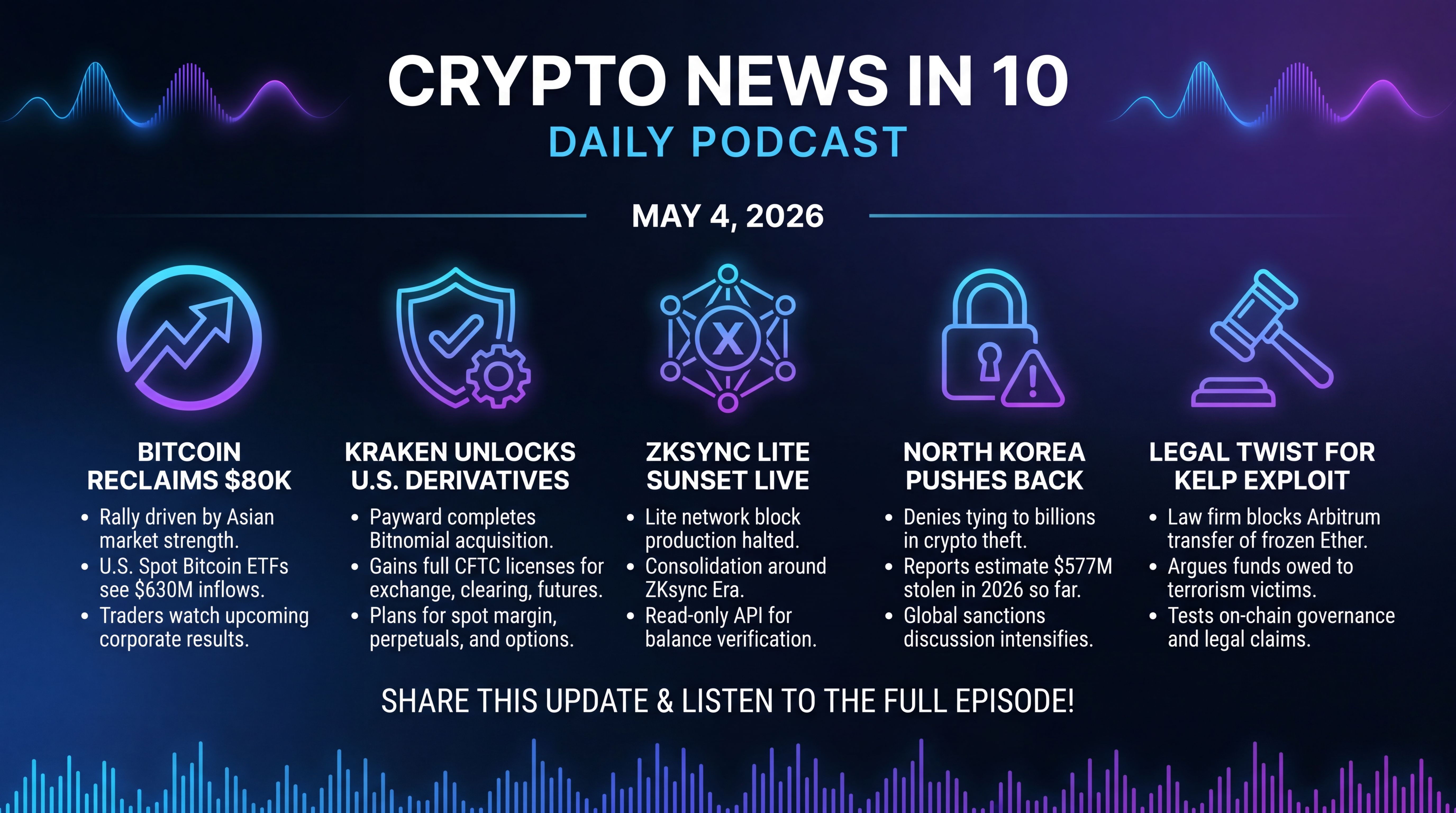
Episode Infographic
Show Notes
Welcome to our Crypto news in 10, a daily podcast bringing you the latest news about crypto in under 10 minutes.
Here’s what’s moving crypto on Monday, May 4.
Bitcoin ripped back above eighty thousand to start the week. Kraken’s parent, Payward, officially closed its Bitnomial acquisition—unlocking a fully regulated U.S. crypto derivatives stack. ZKsync Lite shuts down today as the project consolidates around Era. North Korea is pushing back on reports tying it to billions in crypto theft. And a U.S. law firm is trying to block an Arbitrum transfer of Ether from the Kelp exploit.
Let’s unpack it.
[BEGINNING_SPONSORS]
Story one — Bitcoin is back over eighty thousand.
In the first hours of Monday trading, Bitcoin pushed through the eighty-thousand mark for the first time since late January. TradingView data shows the move began around 1:25 a.m. UTC, climbing from roughly 78,400 and topping out near 80,515 by 4:20 a.m. UTC.
The rally lined up with strength in Asian equities—classic risk-on sentiment spilling into crypto. Ether caught a bid too, up about 3.5 percent near 2,380 dollars during the U.S. evening on Sunday.
And a bit of fuel heading into May: U.S. spot Bitcoin ETFs saw roughly 630 million dollars in net inflows on Friday—their best day in two weeks.
Why it matters... eighty thousand is a big psychological marker. Traders will be watching whether ETF flows, macro sentiment, and this week’s corporate headlines can keep Bitcoin anchored above it. With Strategy—formerly MicroStrategy—reporting first-quarter results tomorrow, Bitcoin treasuries are back in the conversation, and options pricing will hint at whether the market is positioning for a run toward the mid-eighties... or fading the breakout.
Sources: Cointelegraph, CCN.
Story two — Kraken’s parent flips the switch on U.S. derivatives.
Payward, the parent company of Kraken, has completed its acquisition of Bitnomial—giving it the full set of CFTC licenses across exchange, clearing, and futures commission merchant status. That opens the door to a regulated crypto derivatives offering in the United States.
The rollout will start with spot margin on Kraken, with perpetuals and options to follow. Access is expected through Kraken, NinjaTrader, and Payward’s B2B services arm. It’s a major step toward competing head-on with offshore venues—from U.S. soil.
Source: The Block.
A quick rewind.
Payward first announced the deal in mid-April for up to 550 million dollars in cash and stock. The transaction also highlights its distribution footprint after last year’s NinjaTrader acquisition. Today’s close moves it from promise... to pipeline.
Source: Bitnomial.
Story three — ZKsync Lite sunset goes live.
As of today, May 4, ZKsync has halted block production on its original "Lite" network and frozen the chain’s final state—an orderly deprecation the team telegraphed in February as it consolidates around ZKsync Era and the ZK Stack ecosystem.
A read-only API will remain available for at least a year so users can verify balances and history. The team says remaining funds will be claimable via dedicated tooling. If you built on Lite back in 2020 or 2021, this is your reminder to check those old wallets.
Source: The Block.
[MIDPOINT_SPONSORS]
Story four — Pyongyang pushes back.
North Korea blasted recent reporting on state-linked crypto theft as "absurd slander," blaming "reptile media organs" for spreading it—even as blockchain intelligence tallies suggest DPRK-linked actors have lifted roughly 577 million dollars through the first four months of 2026, and more than 6 billion since 2017.
Markets won’t hinge on the war of words, but policy responses might—especially as the U.S. and allies weigh tighter wallet and mixer sanctions.
Source: The Block.
Story five — A courtroom curveball for the Kelp exploit funds.
The law firm Gerstein Harrow says it secured a New York federal court restraining notice and three writs of execution—aimed at blocking the Arbitrum DAO from moving Ether frozen after April’s Kelp exploit. The firm argues its clients—terrorism victims with judgments against North Korea—are owed more than 877 million dollars and have a claim on those seized, DPRK-linked assets.
It’s a fresh legal twist colliding with an ongoing community debate about how to handle recovered funds and restore backing for rsETH. Watch this one—it tests how on-chain governance, sanctions enforcement, and claimant rights interact in real time.
Source: Cointelegraph.
A quick reality check as we wrap.
Bitcoin reclaimed eighty thousand as Asia opened. Payward’s Bitnomial close sets up a regulated U.S. path for perpetuals and options. ZKsync Lite’s shutdown is now official. North Korea’s denial meets on-chain data. And a New York court action could decide what happens to frozen ETH from a major exploit.
Keep an eye on whether Bitcoin can hold above that psychological line... how fast Kraken rolls out new products under CFTC oversight... and what Arbitrum’s community—and the courts—ultimately decide. We’ll be watching it all for you tomorrow.
Thanks for listening and see you tommorow!
