Bullish Buys Equiniti, Telegram Backs TON
Bullish’s $4.2B Equiniti deal ties crypto to core market plumbing, while Telegram doubles down on TON after slashing fees. We also cover Ripple’s security intel push, Coinbase’s SMSF rollout in Australia, and fresh inflows into U.S. Bitcoin and Ether ETFs.
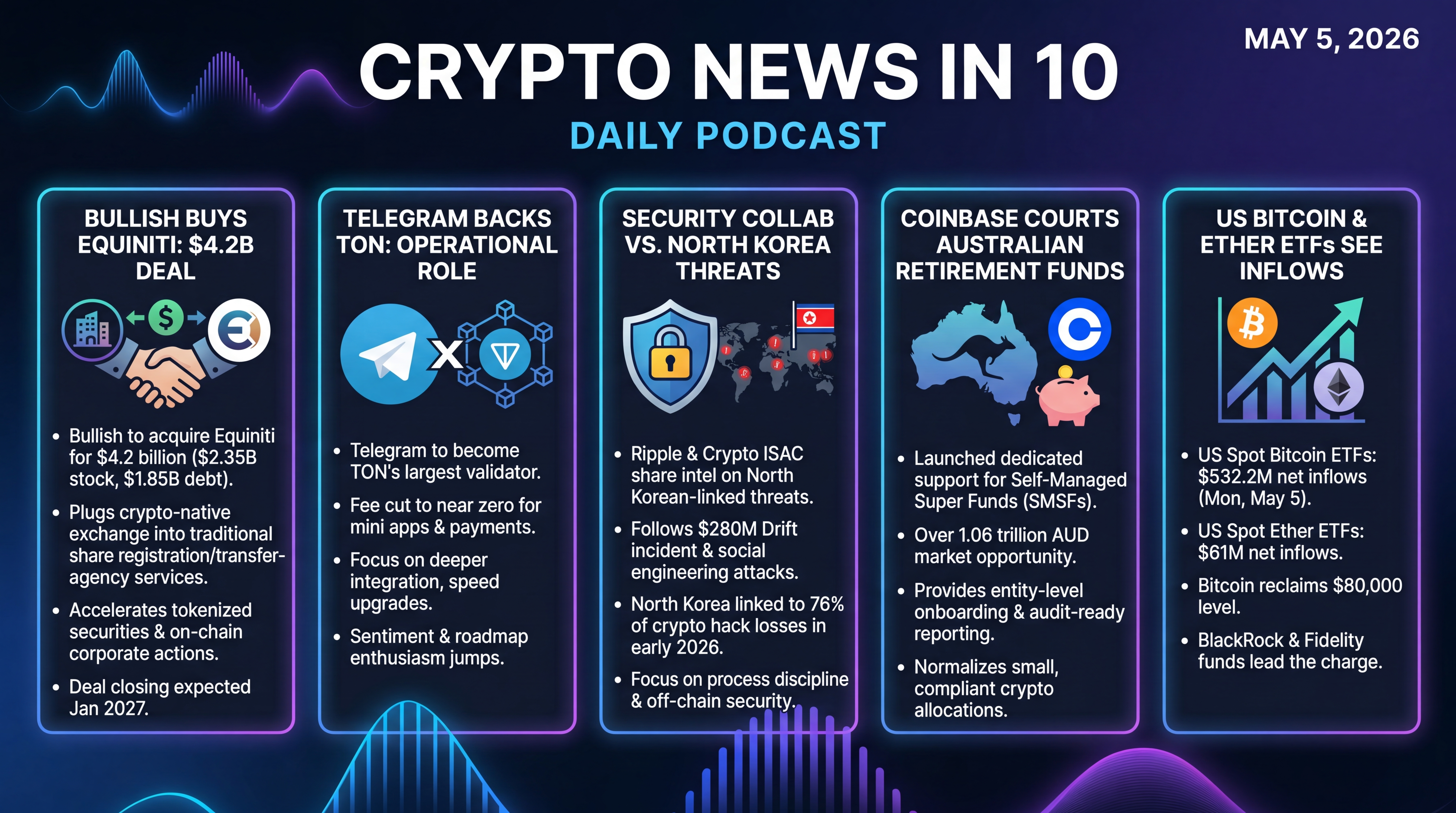
Episode Infographic
Show Notes
Welcome to our Crypto news in 10, a daily podcast bringing you the latest news about crypto in under 10 minutes.
It's Tuesday, May 5, 2026, and here's what's moving crypto today... A major exchange is making a $4.2 billion push into traditional market plumbing. Telegram is tightening its embrace of TON alongside a big fee cut. There's a new security collaboration after sophisticated attacks linked to North Korea. Coinbase is opening the door for Australian retirement money to allocate to digital assets. And U.S. spot Bitcoin ETFs just logged another strong day of inflows — with Ether funds joining the party. Let's jump in.
[BEGINNING_SPONSORS]
First up — the day's biggest deal. Bullish will buy Equiniti from Siris Capital in a transaction valued at $4.2 billion, with roughly $2.35 billion in stock and about $1.85 billion of assumed debt. The agreement also gives Siris an option to buy certain non-core Equiniti business lines, and Bullish expects the deal to close in January 2027.
Strategically, this plugs a crypto-native exchange directly into share registration and transfer-agency services — Equiniti is a heavyweight registrar for U.K. and U.S. corporates. That pairing could accelerate tokenized securities and on-chain corporate actions as the regulated rails mature.
Why it matters... Equiniti says it acts as share registrar to nearly half of the FTSE 100 and ranks as a top-tier U.S. transfer agent by client satisfaction. If Bullish connects those issuer and investor relationships to blockchain-based capital-markets tools, expect faster settlement experiments, programmable dividends, and cleaner audit trails to move from pilots toward production over the next year.
Second — Telegram is stepping further into The Open Network. Founder Pavel Durov says Telegram will become TON's largest validator, taking a more direct operational role in the chain's evolution. This comes right after a roughly sixfold cut in average transaction fees to near zero — a change designed to support Telegram's mini apps and payments. Sentiment around the TON roadmap jumped, with speed upgrades and deeper Telegram integration in focus.
The implications are big. When a platform with hundreds of millions of users commits to validating and integrating a chain, it compresses the distance between consumer experience and on-chain settlement — think in-chat purchases, loyalty, gaming, and micropayments with fewer hops and less friction. Watch whether developer activity and daily active addresses trend up through May and June as those integrations roll out.
Third — security. Ripple is opening up its intelligence on threat actors linked to North Korea to the broader industry via the Crypto ISAC, sharing fraud-associated domains, wallet addresses, and other indicators of compromise. This follows the $280 million Drift incident and a run of attacks that leaned heavily on long-game social engineering rather than pure smart-contract exploits. TRM Labs' recent data underscores the stakes — North Korea was linked to 64% of crypto hack losses in 2025, and 76% through the first four months of 2026.
What to watch... Better threat-intel sharing can speed takedowns and reduce time to freeze stolen funds, but teams also need process discipline. Off-chain operational security, contributor vetting, and staged access are at least as important as on-chain code reviews. The pattern that hit Drift — months of grooming, credible cover capital, and targeted spear-phishing — is likely the template others will face in 2026.
[MIDPOINT_SPONSORS]
Fourth — Coinbase is courting Australia's retirement money. The exchange launched dedicated support for self-managed super funds — Australia's DIY retirement vehicles — with entity-level onboarding, audit-ready reporting, and controls aligned to local accounting standards. It's a big base: as of late 2025, roughly 664,000 SMSFs held about 1.06 trillion Australian dollars in assets. Bringing compliant crypto rails to that segment could normalize small, rules-based allocations to Bitcoin, Ether, and tokenized cash for long-horizon portfolios.
Coinbase framed the rollout as part of a broader Australian push following its financial-services license approval. Trustees can download transaction data for audits and streamline entity verification — a sign exchanges are tailoring product for institutional-adjacent users, not just traders.
Fifth — flows. U.S. spot Bitcoin ETFs pulled in about $532.2 million on Monday, marking a third straight day of net inflows as Bitcoin reclaimed the $80,000 level. BlackRock's iShares Bitcoin Trust and Fidelity's fund took the lion's share. And it wasn't just Bitcoin — U.S. spot Ether ETFs saw roughly $61 million in net inflows the same day, led by BlackRock and Fidelity products. String a few more sessions like this together and momentum could rebuild into mid-May after a choppy first quarter.
Why this matters to price action... Sustained ETF demand tightens the available float at the margin and can cushion volatility when macro headlines hit. But it also raises the bar for catalysts — if flows slow, markets will quickly look to regulation milestones, tokenization deals, and network upgrades to carry the baton.
Quick recap... On May 5: Bullish made a $4.2 billion bid to fuse crypto trading with core equity-market infrastructure via Equiniti. Telegram said it will run TON's largest validator as fees plunge. Ripple and the Crypto ISAC are widening industry access to threat intelligence linked to North Korea. Coinbase is opening crypto access to Australia's roughly 1 trillion Australian dollar self-managed super fund market. And U.S. spot Bitcoin ETFs added about $532 million, while Ether ETFs also saw healthy inflows. We'll keep tracking how these threads — capital-markets plumbing, consumer super apps, security collaboration, compliant on-ramps, and ETF demand — interlock through the week.
Thanks for listening and see you tommorow!
