
AI Agents Pay APIs, CME Bets on Volatility
Solana and Google Cloud debut Pay.sh for stablecoin-powered, pay-per-use AI-to-API access, while Colombia courts renewable Bitcoin mining and a Coinbase DAI freeze heads to court. Plus, CME readies BVX-linked volatility futures with 24/7 trading, and Bitwise projects a $4T stablecoin supply on the back of big-tech pilots.
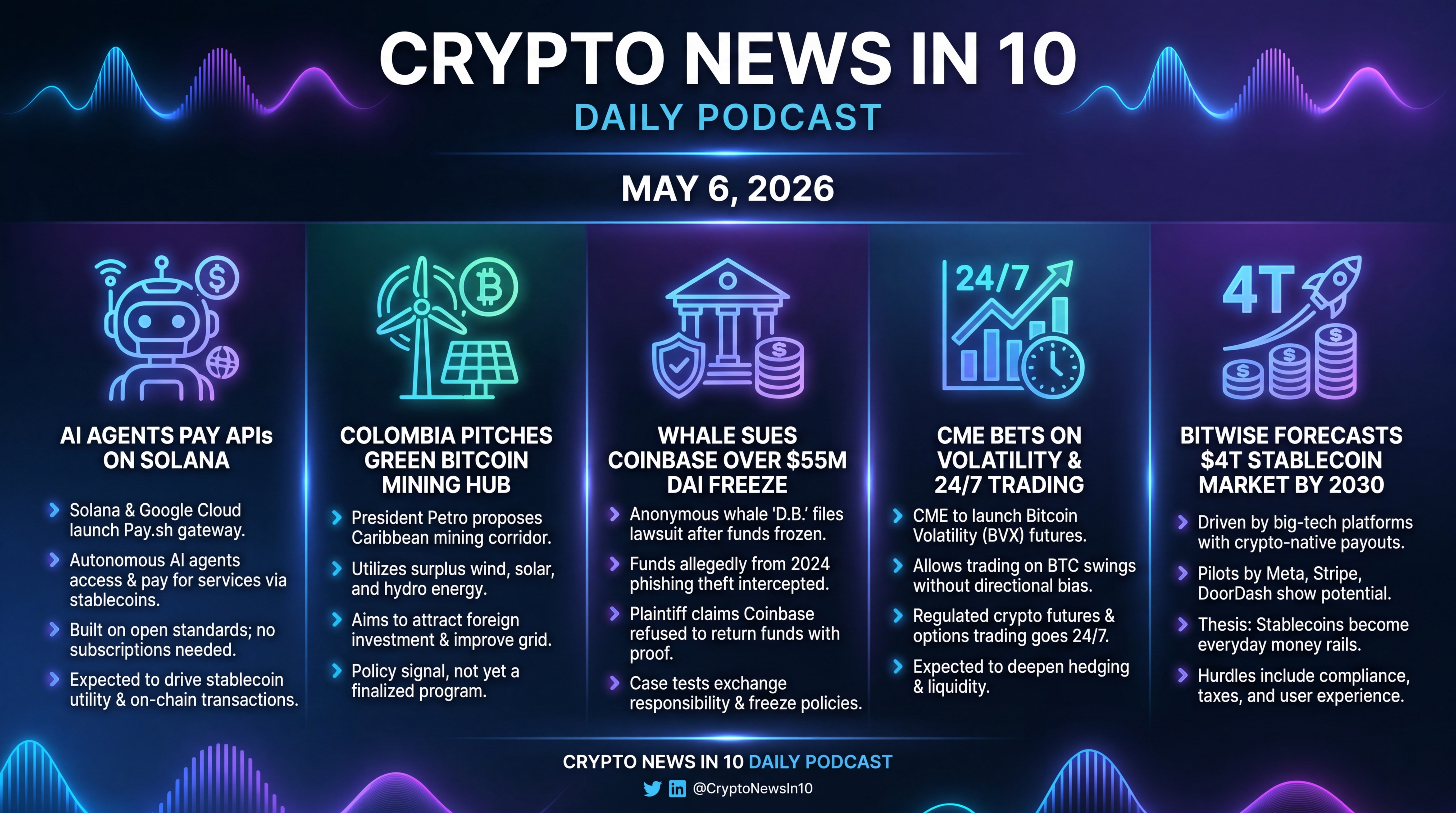
Episode Infographic
Show Notes
Welcome to our Crypto news in 10, a daily podcast bringing you the latest news about crypto in under 10 minutes.
It’s Wednesday, May 6, 2026, and we’ve got a fast-moving mix today... Solana and Google Cloud team up on a new way for AI agents to pay for APIs on demand... Colombia’s president pitches a Caribbean Bitcoin-mining corridor powered by renewables... an anonymous crypto whale sues Coinbase over a $55 million DAI freeze... CME unveils a way to trade Bitcoin’s volatility directly — with 24/7 crypto derivatives trading around the corner... and a bold stablecoin forecast from Bitwise tied to big-tech pilots. Let’s dive in.
[BEGINNING_SPONSORS]
Story one — Solana and Google Cloud launched Pay.sh, a gateway that lets autonomous AI agents discover, access, and pay for APIs per request using stablecoins on Solana.
The Solana Foundation says Pay.sh plugs agents straight into services like Gemini, BigQuery, and Vertex AI. It’s built on open machine-payment standards like Coinbase’s x402 and the Machine Payments Protocol — so developers don’t need traditional accounts or monthly subscriptions.
Think of it this way... software can buy compute and data, one tiny API call at a time, with instant on-chain settlement.
Today’s coverage also notes x402 is moving under Linux Foundation stewardship — a signal the industry wants agent-to-API payments to be interoperable across vendors. If this sticks, we could see steady, utility-driven stablecoin flows on Solana... and a fresh business model for data providers.
Why it matters... AI builders have wanted true pay-per-use for premium APIs — without juggling tokens, rate limits, and invoices across a dozen platforms. Pay.sh flips that. You provision an agent with a balance, it spends autonomously, and providers get instant settlement with minimal overhead.
If even a slice of AI API traffic shifts to this model, expect stablecoin transaction counts on Solana to rise — and more competition to power agent economies.
Story two — Colombia’s president, Gustavo Petro, is pitching the country’s Caribbean coast as a clean-energy Bitcoin-mining hub.
The idea is to tap surplus wind, solar, and hydro in coastal regions to attract miners and high-density data infrastructure — putting Colombia alongside regional players like Venezuela and Paraguay. Petro frames it as an economic development engine that could draw foreign investment and improve grid utilization.
Details are still preliminary — this is a policy signal, not a finalized program — but it’s the clearest national-level mining overture we’ve heard from Colombia to date.
What to watch... execution and community participation. Successful mining expansions in developing regions usually hinge on grid upgrades, long-term power contracts, and local consent — especially where Indigenous communities and sensitive ecosystems are involved. If Colombia moves from statements to RFPs and power-purchase agreements, miners and data-center operators will move quickly.
Story three — an anonymous crypto whale, identified in court papers as “D.B.,” is suing Coinbase in federal court.
The claim is this: after a 2024 phishing theft, Coinbase froze more than $55 million in DAI — then allegedly refused to return the funds, even after the plaintiff provided sworn proof of ownership.
Reports say the hack details line up with a high-profile August 2024 DAI theft. Coinbase hadn’t publicly commented at recording time.
This case will test where the lines are on freezes, evidence thresholds, and who’s responsible when stolen assets are intercepted on centralized platforms.
[MIDPOINT_SPONSORS]
Story four — CME Group is giving traders a way to bet on Bitcoin’s swings without taking a view on direction.
CME plans to launch cash-settled Bitcoin Volatility futures on Monday, June 1, pending regulatory review. The contracts settle to the BVX — a real-time, 30-day, options-implied volatility index — letting funds hedge or express views on how turbulent the next month might be.
In parallel, CME says its regulated crypto futures and options will begin 24/7 trading on May 29. That aligns with the nonstop nature of digital assets — and could shrink the infamous “CME gaps” spot traders love to debate.
Expect cross-market strategies to perk up as the list date approaches: long vol versus options, volatility carry trades, and basis plays between Deribit and CME.
Why it matters... direct volatility products tend to broaden institutional participation. Many macro and vol-arb funds are set up to trade vol, not spot. Adding BVX-linked futures gives them a familiar instrument, risk metrics, and a clearing venue — which can deepen hedging and liquidity across the crypto derivatives stack.
Story five — a big number on stablecoins, and why it might be plausible.
Bitwise CIO Matt Hougan says pilots by large tech platforms could help push stablecoin supply to roughly $4 trillion by 2030, up from about $300 billion today. The thesis is simple: when platforms with hundreds of millions of users turn on crypto-native payouts and settlements, stablecoins graduate from trading chips to everyday money rails.
Recent examples point in that direction. Meta quietly rolled out USDC payouts for creators in Colombia and the Philippines on Solana and Polygon, via Stripe. And reporting in April pointed to DoorDash exploring stablecoin payouts through the Stripe-backed Tempo blockchain.
None of that guarantees Bitwise’s number... but we can see mainstream platforms now testing stablecoins for real payroll and creator economies — not just crypto-to-crypto transfers.
Quick take... the hurdles aren’t just technical. Compliance, taxes, and consumer experience will make or break adoption. But if Stripe, Meta, and peers keep smoothing the edges, stablecoins could become the default cross-border payout rail — with on-chain proofs and near-instant settlement — long before CBDCs arrive at scale.
That’s a wrap. Today we saw AI agents meet on-chain payments via Solana’s Pay.sh... a national-level mining pitch from Colombia... a high-stakes test of exchange responsibilities in the Coinbase DAI case... CME’s new way to trade Bitcoin’s swings — plus 24/7 crypto derivatives trading just weeks away... and a $4 trillion stablecoin vision tied to real pilots by tech platforms.
We’ll keep tracking what turns from headline into hard adoption — and what it means for your portfolio.
Thanks for listening and see you tommorow!
