
New Rules, AI Pays, Kalshi’s Billion, Canton ETF
AUSTRAC’s new AML push, AWS brings USDC to AI agents, Kalshi lands a billion at a 22B valuation, 21Shares debuts a Canton Network ETF, and Kraken’s parent buys Reap for 600M. Your six-minute tour of the rules, rails, and capital reshaping crypto.
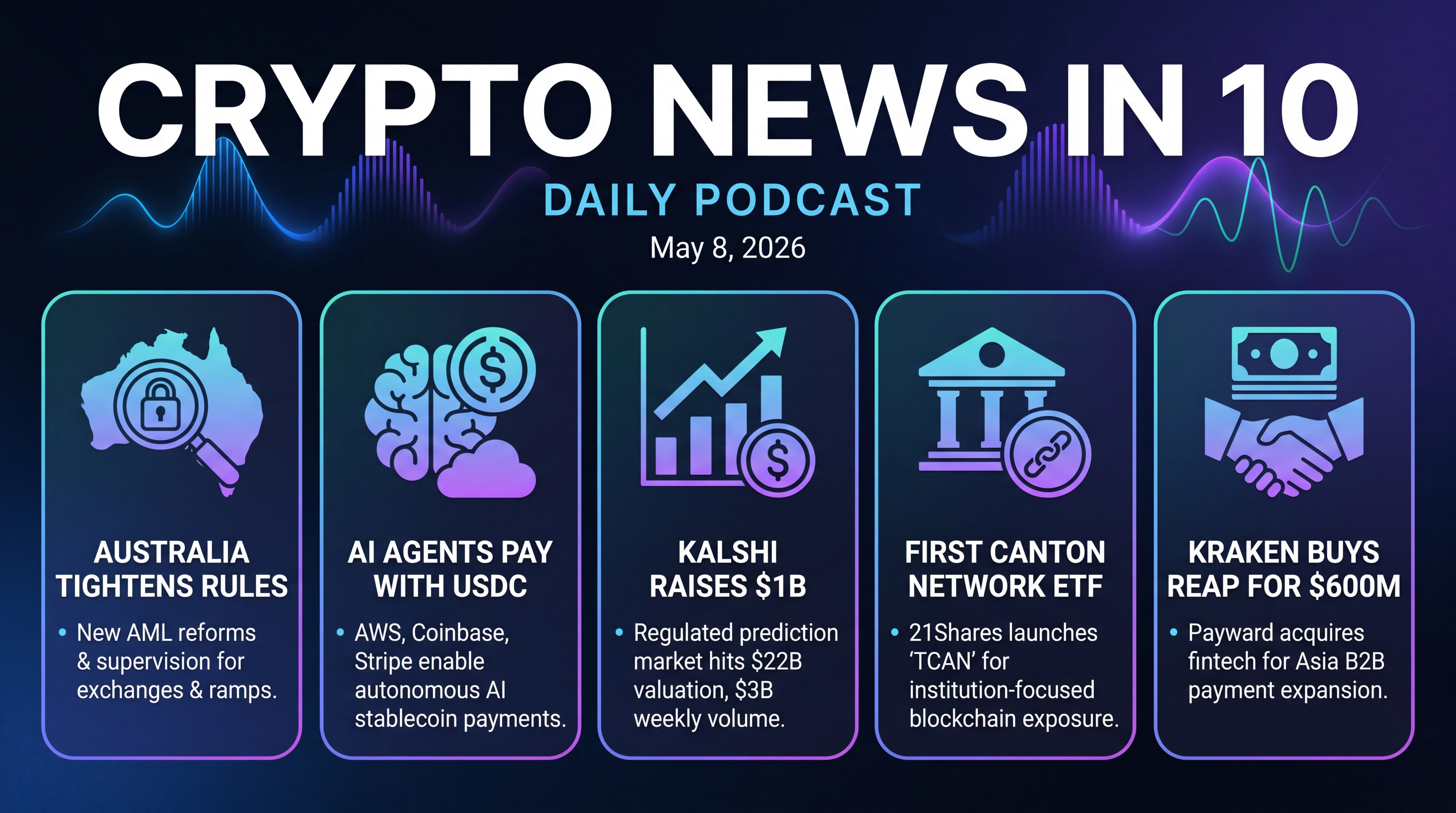
Episode Infographic
Show Notes
Welcome to our Crypto news in 10, a daily podcast bringing you the latest news about crypto in under 10 minutes.
It’s Friday, May 8, 2026. Here’s your quick tour of what’s moving crypto today...
Australia is tightening the regulatory screws with fresh supervision campaigns. Amazon Web Services is wiring up stablecoin payments for autonomous AI agents with help from Coinbase and Stripe. A billion dollar raise pushes regulated prediction market Kalshi to a 22 billion dollar valuation. There’s a first of its kind ETF from 21Shares tied to the Canton Network token. And Kraken’s parent, Payward, is set to buy fintech firm Reap for 600 million dollars, expanding in Asia.
Buckle up.
[BEGINNING_SPONSORS]
Story one — Australia’s financial intelligence agency, AUSTRAC, has launched two targeted supervision campaigns as new anti money laundering reforms take effect for the virtual asset sector.
It’s engaging with 36 over the counter crypto to cash operators — the ramps and rails — and 27 locally registered exchanges. The goal is to test how they manage anti money laundering and counter terrorism financing risk, and how ready they are for a broader rulebook.
The reforms expand coverage beyond traditional exchanges to the full virtual asset service provider stack — custody, brokerage, and more — with travel rule expectations set to kick in on July 1.
AUSTRAC chief Brendan Thomas puts it simply: get firms prepared, and keep criminals out. If you operate in Australia, take this as a nudge to double check governance, customer due diligence flows, and record keeping... before the inspectors call.
Story two — Amazon Web Services is taking stablecoins from slides to production.
AWS rolled out Amazon Bedrock AgentCore Payments — a system that lets autonomous AI agents pay for APIs, data feeds, and other online services with USDC. Under the hood, it uses Coinbase’s x402 protocol — a revival of HTTP 402 — Payment Required — plus Coinbase wallet infrastructure and Privy wallet tech from Stripe.
The pitch is simple. Developers don’t need to bolt on bespoke billing for every data source an agent touches — the agent can just... pay as it goes.
AWS says this could extend to agents that book flights or hotels, with payments settling on chains like Base and Solana. Bottom line, AI plus crypto is moving from concept to utility — and stablecoins are sitting at the center of machine to machine commerce.
Story three — Regulated prediction markets are having a moment.
Kalshi raised 1 billion dollars in a Series F at a 22 billion dollar valuation, led by Coatue, with Sequoia, a16z, IVP, Paradigm, Morgan Stanley, and Ark also involved. Management says the platform now commands about 90 percent of United States prediction market activity, serves 2 million monthly users, and generates roughly 1.5 billion dollars in annualized revenue. Weekly volumes are hitting 3 billion — up massively from a year ago.
The thesis is clear. Event contracts — interest rates, CPI prints, sports, politics — are maturing from novelty into a real, regulated derivatives category. If that momentum keeps compounding, expect integrations with brokers and data terminals... and a louder debate in Washington about how far retail should be allowed to trade the news.
[MIDPOINT_SPONSORS]
Story four — A first in ETF land. 21Shares launched the Canton Network ETF, ticker T C A N, on Nasdaq.
It’s the first United States fund designed to give investors direct exposure to Canton Coin, the native token of the Canton Network — a privacy enabled, institution focused blockchain backed by validators and testers that include Goldman Sachs, Microsoft, and Deutsche Bank.
21Shares says it isn’t just tracking. The firm is an active validator and participates in Global Synchronizer operations on the network.
For institutions that want a compliant wrapper to touch on chain finance rails — and for retail investors who prefer brokerage accounts over wallets — this is a notable bridge between traditional finance plumbing and tokenized market infrastructure.
Story five — Consolidation watch. Kraken’s parent company, Payward, agreed to acquire Reap Technologies, founded in Hong Kong, for about 600 million dollars.
Reap specializes in cross border payments, card issuance, and stablecoin settlement for businesses. The deal signals Kraken’s intent to go deeper into business to business financial infrastructure in Asia — beyond trading and custody — right as stablecoin payments, on chain treasuries, and tokenized receivables take off.
If Payward can bolt Reap’s rails to Kraken’s licenses, liquidity, and brand, it could become a go to stack for companies that want to move money globally, keep balances in stablecoins, and settle around the clock — without the usual correspondent banking friction.
Quick takeaways before we wrap...
Regulators aren’t waiting. AUSTRAC’s trust then verify stance shows how expanded anti money laundering regimes are landing in practice — with travel rule enforcement next.
Big Tech and fintech are standardizing agent payments around USDC — a reminder that stablecoins are becoming the connective tissue of the internet’s economy.
Kalshi’s raise shows regulated prediction markets can scale — fast — when the rules are clear.
And on the market structure side, the Canton ETF and the Kraken and Reap mash up both point to the same destination — tokenized, privacy aware rails that plug straight into the tools companies already use.
That’s your crypto in six minutes — new rules, new rails, and new capital shaping what’s next.
Thanks for listening and see you tommorow!
