
Schwab Adds Crypto, JPMorgan Tokenizes Cash
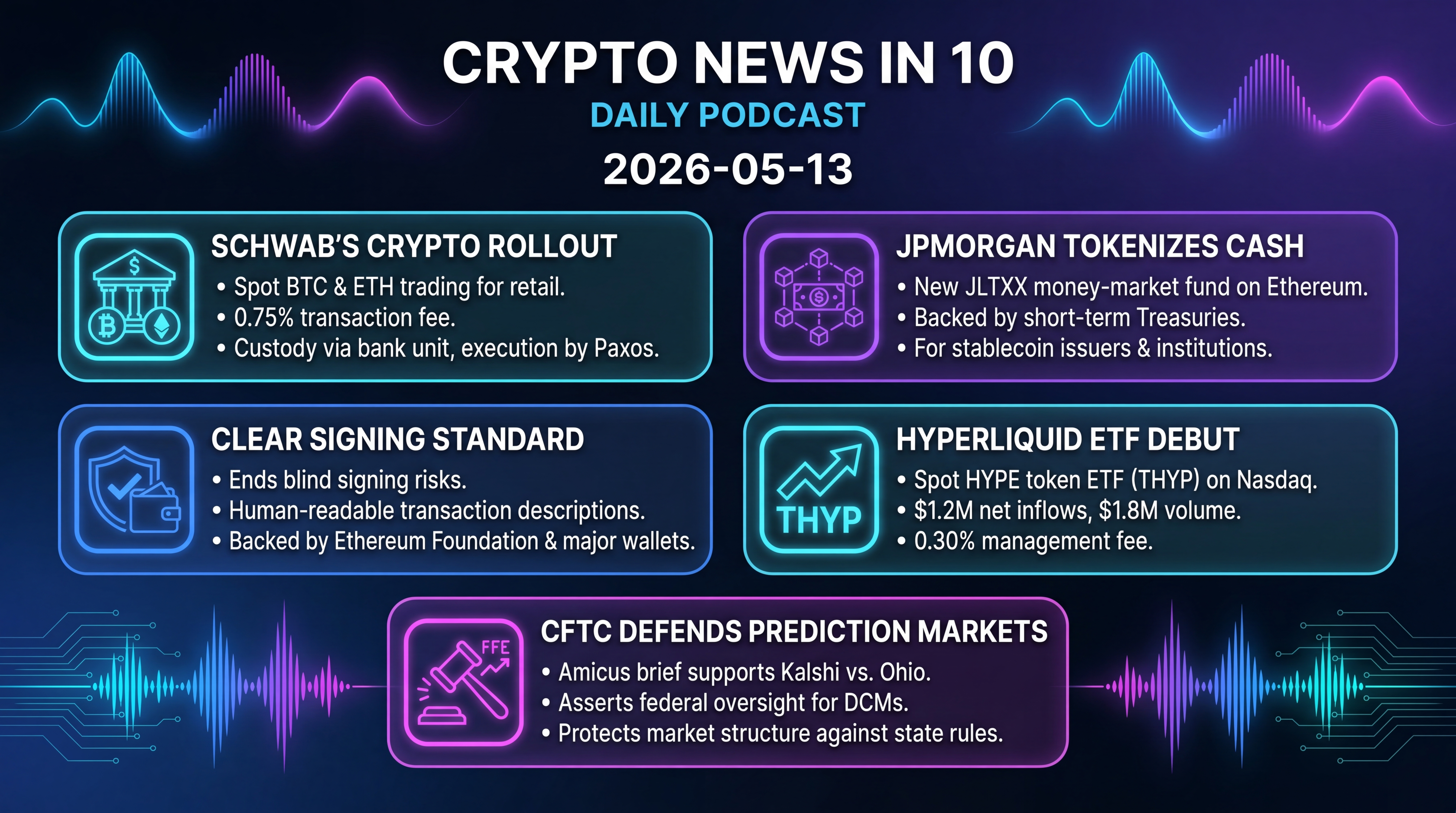
Schwab rolls out spot Bitcoin and Ether trading to retail accounts, while JPMorgan files a tokenized money-market fund on Ethereum. We also cover Ethereum's new Clear Signing standard, Hyperliquid's ETF debut, the CFTC's Kalshi brief, and Base's Azul upgrade.
Episode Infographic
Show Notes
Welcome to our Crypto news in 10, a daily podcast bringing you the latest news about crypto in under 10 minutes.
It's Wednesday, May 13, 2026 — here's what's moving crypto today...
A major U.S. brokerage just turned on direct Bitcoin and Ether trading for everyday investors... JPMorgan filed a new tokenized money-market fund on Ethereum — built with stablecoin issuers in mind... Ethereum's community shipped a security standard to end blind signing... an ETF tied to Hyperliquid's HYPE token logged a respectable first day on Nasdaq... and the CFTC stepped into an appeals battle to defend federal jurisdiction over prediction markets.
Let's get into it.
[BEGINNING_SPONSORS]
First up, mainstream access just took another step forward.
Charles Schwab has begun rolling out spot Bitcoin and Ether trading to its first group of retail clients. Customers can trade crypto right alongside stocks and ETFs in the same brokerage account — with a 0.75 percent transaction fee.
Schwab says the initial rollout excludes New York and Louisiana. Custody sits with its banking unit, while execution runs through Paxos.
The firm serves roughly 39 million active brokerage accounts and holds about 11.77 trillion dollars in client assets — so even a gradual release is a very big pipeline for crypto adoption. Schwab says crypto accounts are rolling out to retail clients now, with the first cohort live today. For tens of millions of Americans, buying Bitcoin could soon feel as routine as buying Apple stock.
Next, JPMorgan is doubling down on real-world assets on public chains.
The bank filed for the OnChain Liquidity-Token Money Market Fund — ticker JLTXX — on Ethereum. According to the filing, the fund would hold ultra-short U.S. Treasuries and overnight repos backed by Treasuries or cash.
The goal is clear — give stablecoin issuers and other institutions a regulated, cash-like on-chain vehicle that actually earns interest, instead of parking idle dollars.
It follows JPMorgan's first tokenized product, the MONY fund, which also runs on Ethereum. The move underscores where tokenization is heading in 2026 — regulated wrappers on public chains, aimed at treasurers and fintechs, not just crypto natives.
Number three is all about security.
The Ethereum community unveiled Clear Signing, a standard designed to end blind signing — those unreadable hex prompts that have contributed to billions in user losses over the years.
Clear Signing, stewarded under the Ethereum Foundation's Trillion Dollar Security Initiative, uses human-readable transaction descriptions and a neutral descriptor registry so wallets can consistently show what you're actually approving before you hit confirm.
Early adopters and contributors include Ledger, Trezor, MetaMask, WalletConnect, Keycard, Argot, and Fireblocks.
The Foundation emphasizes a what-you-see-is-what-you-sign goal, with the initial open standard documented as ERC 7730. Trezor says it's targeting implementation by June 30. Boring... but crucial — this kind of plumbing can reduce phishing and approval-layer exploits for everyone, from retail to institutions.
[MIDPOINT_SPONSORS]
Story four — another altcoin ETF hits Wall Street.
21Shares' Hyperliquid ETF — ticker THYP — made its U.S. debut and drew about 1.2 million dollars in net inflows and roughly 1.8 million dollars in first-day trading volume.
Bloomberg's James Seyffart called it a very solid day for a launch — modest compared with buzzy crypto debuts like the Bitwise Solana product, but notable given current market chop.
THYP tracks the spot price of HYPE, the token of the Hyperliquid perpetuals platform, and carries a 0.30 percent management fee — lower than some rivals targeting the same niche. The launch adds to a growing list of crypto ETPs following the SEC's shift toward generic listing standards for spot crypto ETFs — meaning less case-by-case friction than we saw a year or two ago.
And number five — the CFTC is throwing its weight behind Kalshi in a jurisdiction fight that could shape the future of U.S. prediction markets.
In an amicus brief filed with the Sixth Circuit Court of Appeals, the Commission argues Ohio overreached when it sought to curtail Kalshi's event-contract offerings — asserting that federally regulated designated contract markets, or DCMs, fall squarely under the CFTC's authority, not state gambling rules.
The agency warns that letting states carve out sports or other event contracts would imperil long-standing federal oversight of markets that behave like swaps or binary options.
This isn't just about one venue — it affects competitors like Polymarket and even larger platforms exploring event-driven markets. A win for the CFTC would clarify that regulated prediction markets operate under federal market-structure law, not a patchwork of state gambling regimes.
Quick hits we're watching as you go about your day:
Base's Azul network upgrade — featuring a hybrid T E E plus Z K multiproof design aimed at Stage 2 decentralization — is slated to activate on mainnet today, potentially cutting withdrawal times to about a day and nearly eliminating empty blocks. We'll update you as activation milestones are confirmed on chain.
That's the wrap — Schwab nudges crypto into the default brokerage experience... JPMorgan leans into tokenization rails on Ethereum... Clear Signing makes transactions human-readable... Hyperliquid gets a quiet-but-solid ETF debut... and the CFTC presses a federal case for prediction markets.
We'll keep tracking confirmations and filings as they post — stay tuned for tomorrow's rundown.
Thanks for listening and see you tommorow!
