
Regulators Ease Up, Tokenized Funds Shine
The CFTC loosens reporting for prediction markets, the Bank of England rethinks sterling stablecoin rules, and BitGo posts big revenue but a wider loss. Plus, Elliptic’s $120M raise and Moody’s top ratings for tokenized funds from Fidelity and BlackRock.
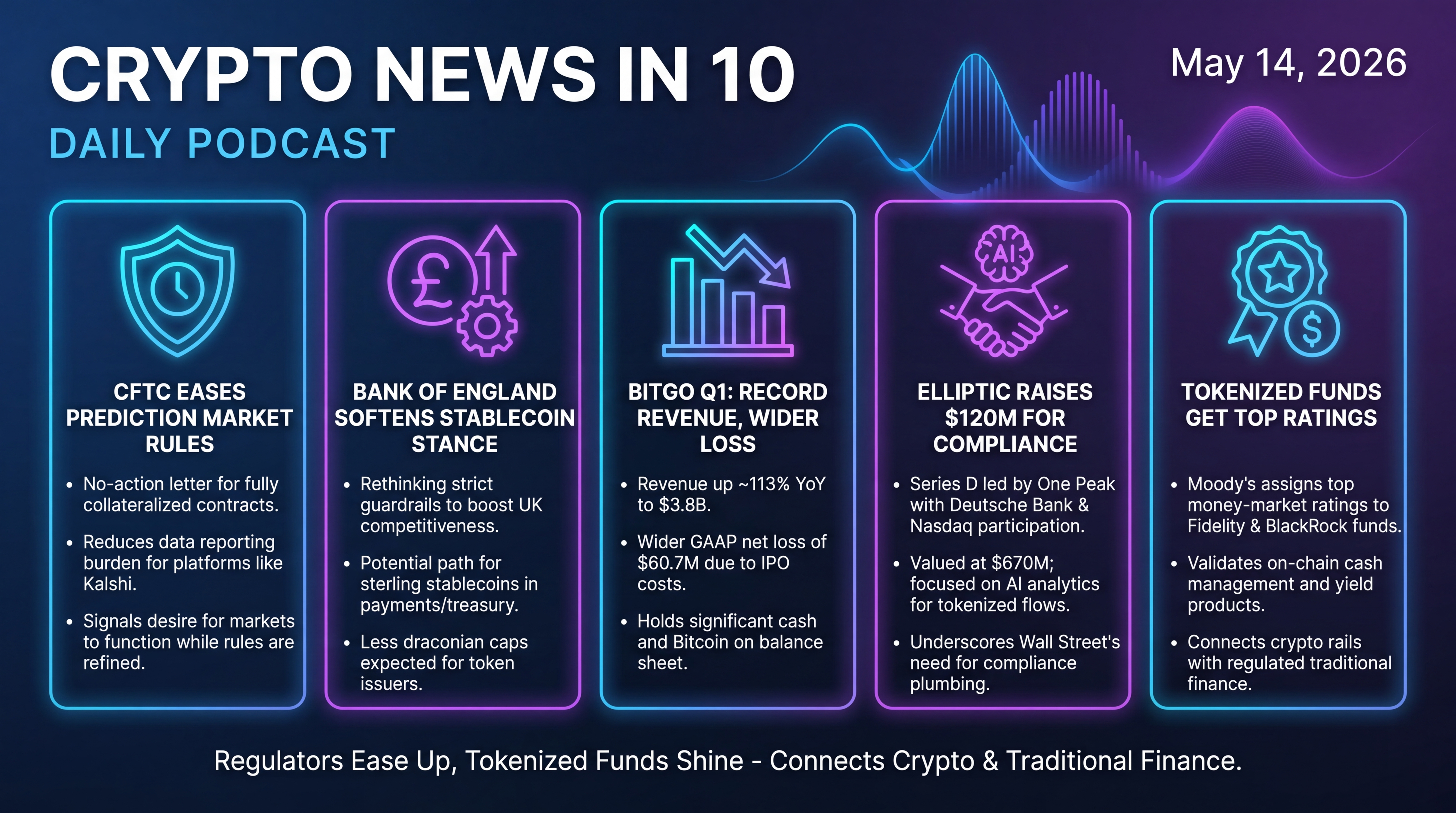
Episode Infographic
Show Notes
Welcome to our Crypto news in 10, a daily podcast bringing you the latest news about crypto in under 10 minutes.
Here’s what’s moving crypto today—Thursday, May 14, 2026.
Fresh regulatory momentum in the U.S. The Commodity Futures Trading Commission—the C F T C—issued a no-action letter easing data reporting for fully collateralized prediction-market contracts. Across the pond, the Bank of England is rethinking guardrails for sterling stablecoins. On the corporate side, BitGo’s first quarter as a public company shows blockbuster revenue, but a wider loss. Compliance heavyweight Elliptic raised a big round led by mainstream finance. And Moody’s just handed top-tier money-market assessments to tokenized funds from Fidelity—and, separately, BlackRock.
Let’s get into it...
[BEGINNING_SPONSORS]
Story one: the C F T C just gave prediction markets some breathing room.
A staff no-action letter from the market and clearing divisions says they won’t recommend enforcement for missing certain swap-data submissions and recordkeeping tied to fully collateralized event contracts. In plain English, platforms and designated markets listing these contracts don’t have to route those transactions to swap data repositories—at least while the agency refines the rules.
It’s targeted relief, but meaningful for operators like Kalshi and Polymarket, who’ve been juggling overlapping state-versus-federal regimes and heavy compliance overhead. The move lands as the Commission more loudly defends its jurisdiction over event markets... and ahead of broader rulemaking. Expect more clarity to follow. Sources: CFTC press release and industry coverage.
Why it matters: data reporting is costly and operationally fussy for small teams. Pulling that burden back—even temporarily—reduces friction, likely keeps more liquidity onshore, and signals the agency wants markets to function while permanent rules get hammered out. It’s not a blank check, though—platforms still have to meet the letter’s conditions and all anti-fraud obligations. Sources: CFTC materials and today’s reports.
Story two: the Bank of England is signaling a softer stance on sterling stablecoins.
In a Financial Times interview, Deputy Governor Sarah Breeden said the Bank is looking very hard at alternatives to its proposed regime—essentially conceding the initial draft may have been too conservative. Translation: limits, backing rules, and operational constraints for U.K.-denominated stablecoins could be eased to keep Britain competitive as the U.S. and E.U. sprint ahead with their own frameworks.
For token issuers and payments firms, that suggests a door is opening for more pragmatic rules that still protect financial stability. Sources: FT interview, Reuters reporting, and industry press.
The practical takeaway: if the Bank softens its approach, sterling stablecoins could find a path to real-world payments and treasury use in the City—without draconian caps that strangle product design. Keep an eye on consultation updates and how the F C A aligns its conduct rules. Sources: Reuters and The Block.
Story three: BitGo’s first quarter as a public company is in—and it’s a study in scale versus profitability.
The crypto infrastructure firm reported three point eight billion dollars in first-quarter revenue, up roughly one hundred thirteen percent year over year, but posted a wider G A A P net loss of about sixty point seven million dollars, citing bitcoin price effects and I P O-related costs. Management also highlighted approximately one hundred eighty-six point six million dollars in cash and about one hundred sixty-seven million dollars’ worth of bitcoin on the balance sheet at quarter end. Sequentially, revenue fell versus the prior quarter as business mix shifted and derivatives rolled out—still, it’s a massive top line for a custody-plus-prime platform. Sources: BitGo investor materials, call highlights, and industry coverage.
What to watch next: margins and revenue quality. If more of BitGo’s growth comes from trading and derivatives, investors will look for durability and risk controls across cycles—and for how quickly the firm can translate its custody scale into fee-efficient profit. Sources: earnings materials and news reports.
[MIDPOINT_SPONSORS]
Story four: compliance money keeps flowing—Elliptic just raised one hundred twenty million dollars.
The London-based blockchain analytics firm closed a Series D led by One Peak, with participation from Deutsche Bank, the British Business Bank, and Nasdaq Ventures, valuing the company around six hundred seventy million dollars. Elliptic’s pitch is clear: as banks and asset managers touch stablecoins, tokenized funds, and on-chain payments, they need industrial-grade screening across dozens of chains and stablecoin rails. The new capital is earmarked to expand AI-native analytics and risk tooling for incumbents stepping into crypto. Sources: FintechFutures and Bloomberg.
The signal here: Wall Street wants compliance plumbing as tokenization scales. When Deutsche Bank and Nasdaq deepen bets on analytics, it’s because their clients are pushing into digital-asset flows and can’t afford compliance blind spots. Expect this to intensify as more tokenized cash and securities come online.
Story five: tokenized funds just got a mainstream credibility boost.
Fidelity International launched its first tokenized U.S. dollar liquidity fund—ticker F I L Q—built on Sygnum’s Desygnate platform with Chainlink infrastructure, and Moody’s assigned it the top money-market rating. Separately, reporting notes BlackRock’s tokenized Treasury product also carries an equivalent top-tier assessment.
Why it matters: money-market-style vehicles with round-the-clock on-chain subscriptions and redemptions—plus blue-chip risk marks—are the connective tissue between crypto rails and traditional cash management. Institutions get yield and programmatic access... crypto-native firms get regulated liquidity instruments on public-chain plumbing. Sources: Sygnum announcements and industry updates.
Quick recap: today the Commission eased reporting on event-contract markets while it crafts permanent rules... the Bank of England signaled a friendlier, more competitive path for sterling stablecoins... BitGo’s first quarter showed enormous scale but a wider loss post-I P O... Elliptic’s one hundred twenty million dollar raise underscored demand for compliance in a tokenized world... and Moody’s gave top-tier marks to tokenized liquidity funds from Fidelity—and, as reported, BlackRock—putting fresh polish on on-chain cash products.
We’ll keep tracking outcomes from the Senate’s CLARITY Act markup later today—and how these regulatory shifts translate into real products you can actually use. Sources: CFTC, FT and Reuters, BitGo filings and coverage, FintechFutures and Bloomberg, and Sygnum with industry reports.
Thanks for listening and see you tommorow!
