
ATM Giant Shutters, Bridge Hack, Bitcoin at Sea
Bitcoin Depot moves to Chapter 11, a Verus–Ethereum bridge exploit drains $11.6M, and Iran-linked reports tout Bitcoin-settled maritime insurance. Plus, a Paris-listed treasury stacks more BTC and a Senate stablecoin compromise could tilt the field toward USDC.
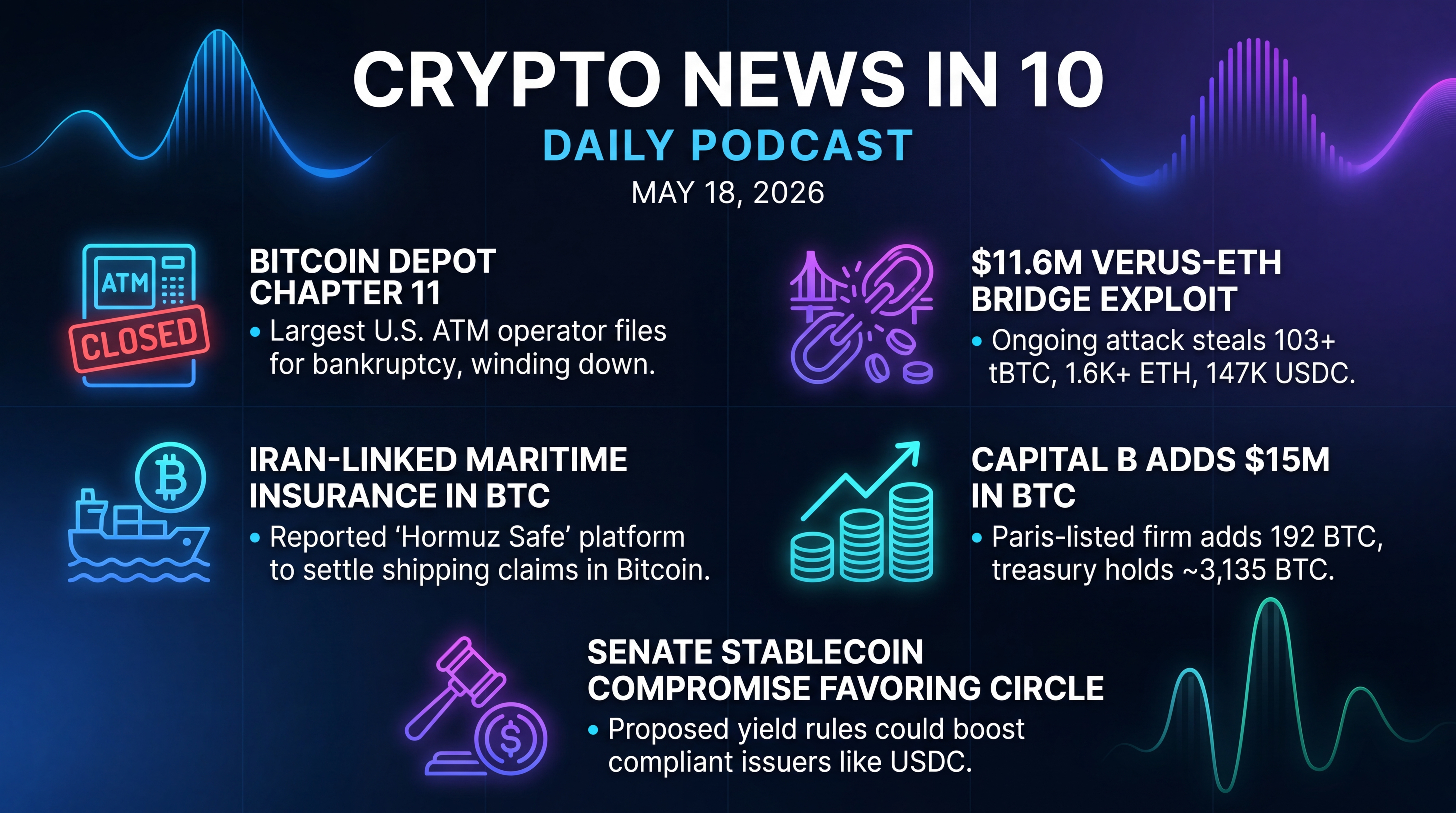
Episode Infographic
Show Notes
Welcome to our Crypto news in 10, a daily podcast bringing you the latest news about crypto in under 10 minutes.
It's Monday, May 18, 2026, and here's what's moving crypto...
We've got a U.S. crypto ATM operator seeking Chapter 11 protection and planning to shut down, a fresh bridge exploit draining roughly 11.6 million dollars, and an Iran-linked rollout that claims to settle maritime insurance in Bitcoin.
In Europe, a Paris-listed treasury firm tops up its stack with a 15 million dollar Bitcoin buy. And on the policy front, a new analyst note says the Senate's stablecoin yield compromise could tilt the market toward Circle. Let's get into it.
[BEGINNING_SPONSORS]
Story one: Bitcoin Depot — the largest U.S. crypto ATM operator by footprint — has filed for Chapter 11 in the Southern District of Texas and says it plans to wind down operations. The Nasdaq-listed company points to state rules tightening across the map — lower transaction caps, tougher K Y C and A M L checks, and in some places, outright restrictions — as the core reason its current model isn't sustainable.
The move follows an April security incident where attackers stole about 3.7 million dollars from company wallets, along with preliminary, unaudited first-quarter results showing revenue down roughly 49 percent year over year. Reporting from The Block underscores the broader pressure on brick-and-mortar on-ramps as more trading drifts into apps and brokerages.
Bigger picture: after a decade of boom-and-bust cycles for Bitcoin kiosks in convenience stores and gas stations, Chapter 11 for a market leader is a signal. Regulatory fragmentation, payment-fraud risks, and rising operating costs are squeezing margins. If you rely on a Bitcoin ATM for cash to crypto, you may soon have to shift to bank transfers or brokerage rails as these machines go dark... and that could push even more volume into compliant, fully K Y C verified channels.
Story two: another cross-chain hit. The Verus-to-Ethereum bridge is facing an ongoing exploit identified late Sunday by security firm Blockaid and flagged by others including PeckShield. About 11.6 million dollars has been siphoned so far, with reported losses spanning roughly 103.6 t B T C, 1,625 ETH, and 147,000 USDC.
Investigators shared an attacker address and warned activity was still live during the initial window. According to reporting from The Block and Cointelegraph, it's a sobering reminder — bridges remain DeFi's weakest link, even when core protocol contracts aren't directly at fault.
Why it matters: 2026 has already seen a series of bridge-related incidents, and each one reinforces what regulators and insurers focus on — operational risk sits at the edges where chains meet. For users, practical defenses haven't changed: minimize time and value parked in bridge contracts, prefer native assets when possible, and verify routes in your wallet before you sign... especially as Clear Signing rolls out more broadly across major tools.
Story three: a geopolitical curveball. An Iran-linked outlet says a state-backed platform called 'Hormuz Safe' will provide maritime insurance for cargo transiting the Strait of Hormuz — settling premiums and claims in Bitcoin. The report, traced by The Block to Fars News, ties the claim to Iran's Revolutionary Guard. Officials are touting potential revenue that could top 10 billion dollars if the platform captures a meaningful slice of Gulf shipping.
Independent confirmation is still thin, so treat this as developing — but the idea alone is notable: hard-to-sanction, crypto-settled insurance for one of the world's most sensitive shipping lanes.
If even part of this materializes, it would show how crypto rails can become parallel financial plumbing where traditional correspondent banking is brittle or politically constrained. It also raises obvious questions: how would reinsurers treat B T C settled claims, how would compliance screens handle counterparties, and could secondary sanctions ensnare service providers that touch these flows? We'll keep watching for verification and market reaction as details emerge.
[MIDPOINT_SPONSORS]
Story four: in Europe, France-listed Capital B — formerly The Blockchain Group — added 192 Bitcoin to its treasury today, spending roughly 13 million euros, or about 15 million dollars, from a fresh capital raise. The company says it completed three capital-increase transactions totaling around 17.15 million euros, with participants including Blockstream's Adam Back and asset manager TOBAM.
Post-purchase, Capital B reports holdings of 3,135 Bitcoin, with disclosures pointing to an aggregate acquisition value near 330 million dollars. It's another data point in the corporate-treasury adoption story — more conservative than the flashier balance-sheet wagers of the past, but steady and public.
What to watch: European corporates have shown growing interest in Bitcoin as an alternative reserve alongside tokenized cash equivalents. With euro-area rates easing and MiCA's frameworks bedding in, treasuries may feel incrementally safer holding a slice of Bitcoin or tokenized cash in parallel — especially for firms with crypto-native operations or investor bases. Today's move won't swing markets, but it reinforces the narrative that publicly listed entities can accumulate programmatically, disclosures and all.
Story five: policy meets markets. Analysts at Bernstein argue the Senate's stablecoin yield compromise inside the CLARITY Act could structurally favor Circle's model as stablecoin supply hits new highs. The committee advanced the bill in a 15 to 9 vote on Thursday, with language that curtails passive, bank-like interest on payment stablecoins while allowing activity-based rewards — think using a coin rather than parking it.
Bernstein's take: the compromise protects the economics of compliant issuers that already lean on reserve income and enterprise payment use cases, potentially reinforcing USDC's competitive position if the bill becomes law.
Context matters here. Stablecoin design is now a legislative question, not just a product feature. If passive yield is constrained but utility rewards are allowed, exchanges and wallets may pivot from "park and earn" to "spend and earn" — and merchants could see richer incentive programs riding on-chain. That's a very different market than 2021's deposit-style payouts... and it could accelerate integrations where stablecoins act as pure payments plumbing.
Quick recap... Bitcoin Depot's planned wind-down shows how state rules and security incidents are reshaping physical on-ramps. Another bridge exploit — this time Verus's Ethereum link — highlights that cross-chain risk is still the soft underbelly. Iran-linked reports of Bitcoin-settled maritime insurance hint at crypto's role in geopolitical finance, though verification is pending. In Paris, Capital B keeps stacking with a 15 million dollar buy. And on the Hill, analysts say the Senate's stablecoin yield compromise could lock in an advantage for Circle's model as supply keeps climbing. We'll be back tomorrow with the latest.
Thanks for listening and see you tommorow!
