
Bitcoin ETF Shake-Up, Tokenized Stocks Loom
Bitcoin ETFs see their biggest daily outflow since January as Washington eyes a new path for tokenized stocks. Plus, Minnesota greenlights bank custody, Galaxy wins a BitLicense, and Echo Protocol’s Monad exploit unpacks key security lessons.
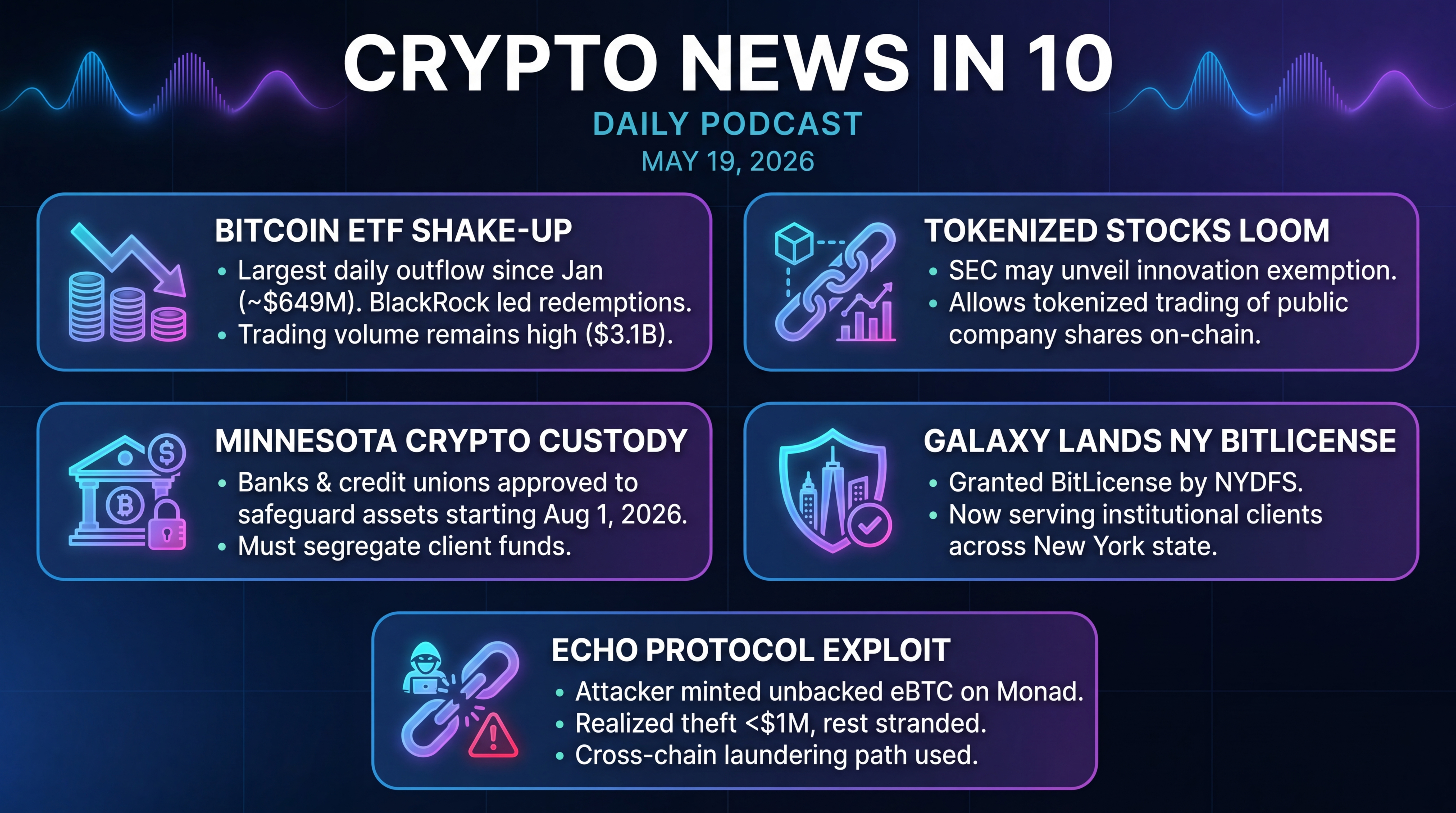
Episode Infographic
Show Notes
Welcome to our Crypto news in 10, a daily podcast bringing you the latest news about crypto in under 10 minutes.
Here's what's moving crypto today — Tuesday, May 19, 2026.
A big swing in U.S. spot Bitcoin ETF flows — the largest daily outflow since January. In Washington, the SEC is reportedly readying an innovation exemption that could open the door to broader tokenized stock trading. On the state front, Minnesota just authorized banks and credit unions to custody crypto, with an August start date. In New York, Galaxy picked up a coveted BitLicense to serve institutional clients. And we'll close with a fresh exploit: Echo Protocol on Monad was abused to mint unbacked eBTC and siphon funds... let's get into it.
[BEGINNING_SPONSORS]
Story one — flows.
U.S. spot Bitcoin ETFs saw about 649 million dollars in net outflows on Monday, May 18 — the largest daily redemption since late January. BlackRock's iShares Bitcoin Trust led with roughly 448 million pulled, followed by ARK 21Shares at about 110 million, and Fidelity's FBTC around 63 million.
Despite the selling, trading was heavy — more than 3.1 billion dollars in turnover — a sign institutions are actively repositioning, not disappearing. Category assets sit near 100 billion dollars, just over 6.5 percent of Bitcoin's market cap. Watch whether this reversal extends or stabilizes this week... it's a primary driver of intraday sentiment.
Story two — tokenized stocks.
Bloomberg reporting, echoed by industry press today, says the SEC could unveil an innovation exemption as soon as this week. It would allow tokenized trading of public company shares on blockchain rails — even through third-party tokens that issuers didn't mint themselves.
Details are still being finalized, and not everyone at the Commission is on board, but the direction is noteworthy. It hints at an on-chain path for equity-like instruments, with expected rights like voting and dividends — otherwise, tokens could face delisting under the policy.
Industry voices are weighing in. Securitize president Brett Redfearn cautions that tokenizing without the issuer at the table could fragment markets and confuse price discovery. If this lands, it could reshape how brokers, alternative trading systems, and crypto venues think about equity exposure — alongside other recent tokenization pushes by incumbents.
Story three — a state-level green light.
Minnesota Governor Tim Walz has signed House File 3709, allowing state-chartered banks and credit unions to offer virtual-currency custody services starting August 1, 2026. Institutions can safeguard crypto — including control of private keys — in either fiduciary or non-fiduciary roles, can use qualified third-party sub-custodians, and must segregate client assets.
They have to give 60 days' notice to the commerce commissioner before launch and implement strong risk, cybersecurity, business continuity, and compliance policies. For consumers and regional institutions, this creates a regulated, familiar alternative to exchange custody — and it may nudge more community banks to experiment with digital-asset offerings under state supervision.
[MIDPOINT_SPONSORS]
Story four — a New York milestone.
Galaxy Digital has received a BitLicense and a Money Transmission License from New York's Department of Financial Services, for its GalaxyOne Prime NY entity. That authorizes the firm to offer regulated digital-asset services to institutions across the state.
Galaxy says it now directly serves New York registered investment advisers, hedge funds, and family offices — tapping what it calls the deepest pool of institutional capital — and notes a global regulatory footprint with more than 50 licenses. NYDFS remains one of the most demanding crypto jurisdictions in the U.S. Winning a BitLicense is still a strong signal of compliance maturity and product readiness for institutional clients that require New York access.
Story five — security watch.
Echo Protocol, a Bitcoin-focused DeFi platform, was exploited on its Monad deployment. An attacker minted 1,000 eBTC — Echo's wrapped BTC token — without backing.
On-chain analysts say the attacker deposited 45 eBTC as collateral on Curvance, borrowed about 11.29 WBTC — around 868,000 dollars at the time — bridged those funds to Ethereum, swapped to ETH, and sent the proceeds through Tornado Cash.
In short... roughly 77 million dollars in notional eBTC appeared, but the realized theft was under a million — the rest was stranded because the market recognized the mint as illegitimate. It's another reminder that admin keys and collateral-admission logic can be single points of failure in young ecosystems — and that cross-chain liquidity paths remain a favored avenue for laundering. Expect deeper post-mortems on Echo's role definitions and Curvance's collateral checks in the days ahead.
Quick recap...
ETF flows flipped hard, with nearly 649 million dollars in net outflows — we'll watch whether that persists. The SEC is reportedly prepping an innovation exemption to widen tokenized stock trading. Minnesota gave banks and credit unions the green light to custody crypto starting August 1, 2026. Galaxy secured a New York BitLicense to serve institutions. And the Echo exploit showed — again — how admin controls and cross-chain routes can be abused. Same time tomorrow for more crypto in ten.
Thanks for listening and see you tommorow!
