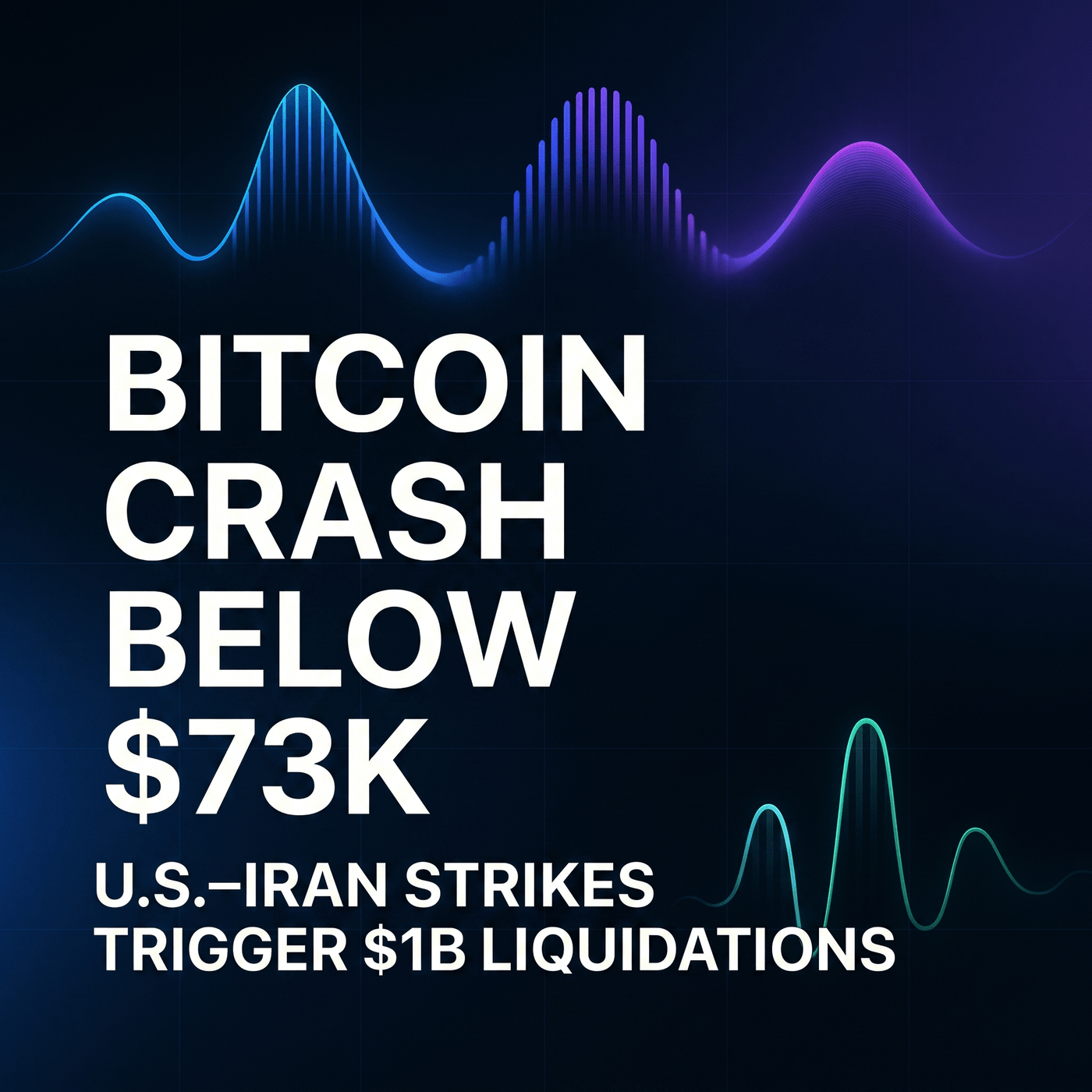
Strait Shock: Bitcoin Slips, ETFs Bleed, Ether Diverges
Geopolitical strikes spark a risk-off wave as Bitcoin dips below $73K and spot ETFs see heavy outflows, while ether breaks $2K even as open interest hits records. We also track Washington’s prediction-market review and a rare CFTC move to unwind its Gemini settlement.
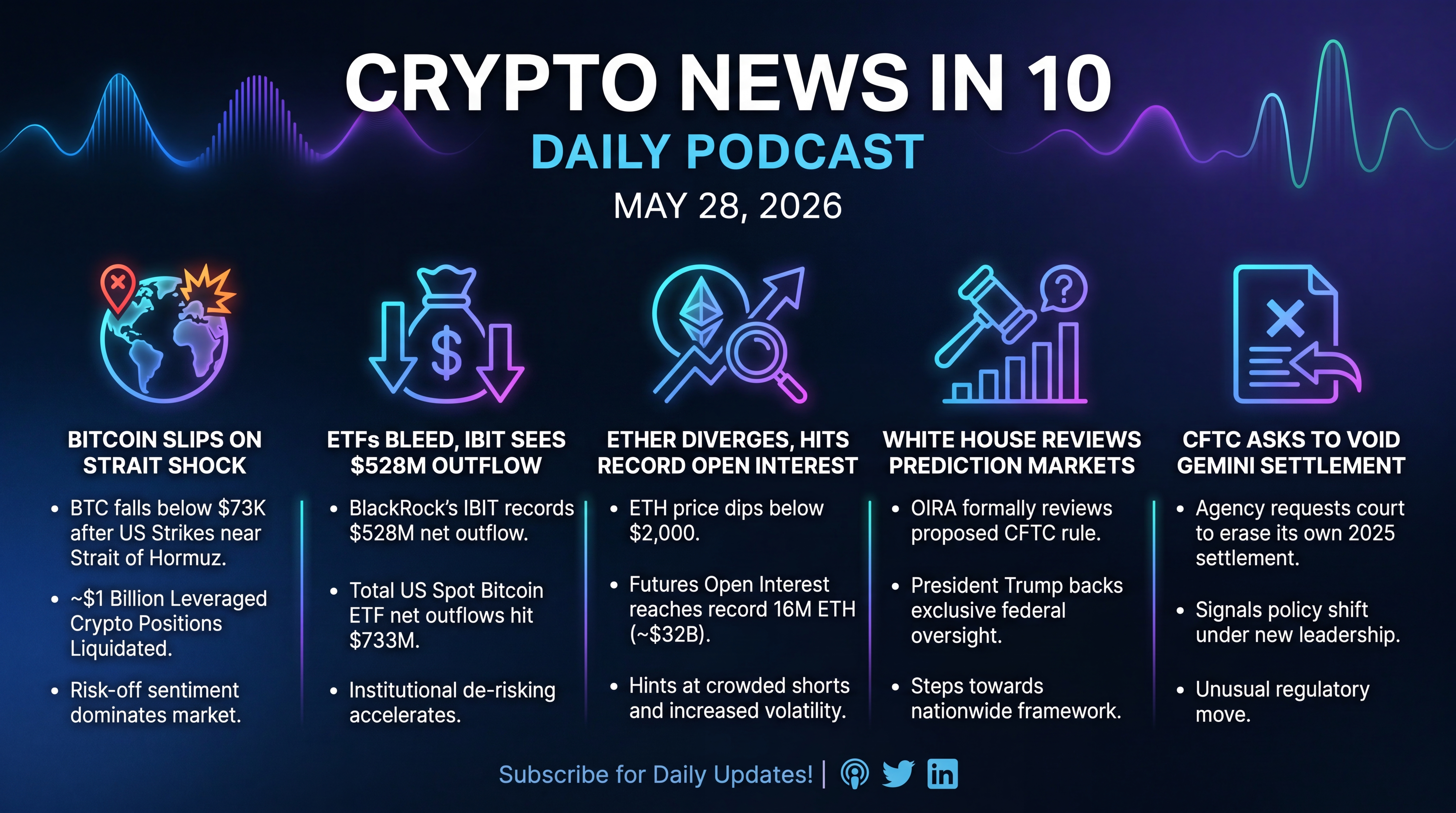
Episode Infographic
Show Notes
Welcome to our Crypto news in 10, a daily podcast bringing you the latest news about crypto in under 10 minutes.
It’s Thursday, May 28, 2026, and here’s your rapid rundown of the five crypto stories that matter most today.
Markets first: Bitcoin briefly fell below $73,000 overnight after the United States confirmed strikes on an Iranian target near the Strait of Hormuz. That shock flipped risk sentiment, triggered one of the year’s biggest liquidation waves, and set the tone across majors. We’ll unpack that move… then the eye‑popping $528 million outflow from BlackRock’s bitcoin ETF — and why ETF flows now look decisively risk‑off… then a surprising divergence in ether, where price broke $2,000 even as futures open interest hit a record 16 million ETH. We’ll close in Washington with two policy headlines: the White House moving a CFTC rule on prediction markets into formal review, and the CFTC asking a court to erase its own Gemini settlement from last year. Buckle up.
[BEGINNING_SPONSORS]
Story one: the macro shock.
Bitcoin slid below $73,000, and ether lost the $2,000 level after United States airstrikes near the Strait of Hormuz reignited geopolitical worries. Nearly $1 billion in leveraged crypto positions were liquidated over 24 hours — about 93% of them longs — showing traders had been leaning bullish into the headlines and got caught wrong‑footed.
It wasn’t just spot. Derivatives desks reported heavy long wipeouts, with the largest single liquidation around $15 million on a bitcoin position. As the U.S. morning began, equity futures also softened — underscoring the risk‑off tone. Source: CoinDesk.
Story two: the ETF pressure valve opened — hard.
BlackRock’s iShares Bitcoin Trust, IBIT, logged about $528 million in net outflows on Wednesday — the second‑largest daily draw since launch and just shy of its January record. Across the U.S. spot bitcoin ETF complex, net outflows hit roughly $733 million that day, extending a multi‑session streak that has now pulled more than $2 billion over about two weeks.
One factor looming over the tape: a $1.29 billion dark‑pool block trade in IBIT on Tuesday. While not itself an outflow, it signaled that large holders were trimming exposure. With bitcoin breaking $73,000, those redemptions likely forced issuers to sell underlying BTC to meet exits — amplifying the pressure. IBIT still holds about $59 billion in assets and roughly 4% of bitcoin’s supply, but May has clearly flipped from accumulation back to distribution. Source: CoinDesk.
Story three: the ether divergence.
Ether dipped below $2,000 for the first time since March, yet futures open interest hit an all‑time high around 16 million ETH — more than $32 billion at current prices. That combination — falling price and rising open interest — typically points to traders adding shorts rather than buying the dip.
Headwinds include persistent ETF outflows in the U.S., recent high‑profile departures from the Ethereum Foundation that are feeding a governance debate, and a lingering question over how Ethereum’s surging on‑chain activity actually accrues to the ETH token in this cycle. Net of it all, the market is positioned for more two‑way volatility into month‑end — with a bearish tilt on ether specifically. Source: CoinDesk.
[MIDPOINT_SPONSORS]
Story four: Washington moves on prediction markets.
The White House’s Office of Information and Regulatory Affairs has formally taken up a proposed CFTC rule on prediction markets, kicking off the economic and policy review required before a major rule can publish. The timing follows President Trump’s recent post backing exclusive federal oversight by the CFTC, even as several states argue that some event contracts resemble online gambling under state law.
Earlier this year, the CFTC asked for input on which types of contracts — elections, gaming, sports — might be barred as contrary to the public interest. Today’s OIRA review is a concrete step toward a nationwide framework and could define how platforms like Kalshi and Polymarket operate across state lines. Source: CoinDesk.
A quick related note: in a separate case highlighting the growing law‑enforcement focus on these markets, federal authorities charged a Google security engineer with insider trading on Polymarket using nonpublic search‑trend data — underscoring why regulators want clearer guardrails for event contracts. These are allegations at this stage. Source: CoinDesk.
Story five: a striking enforcement reversal.
Overnight, the CFTC asked a federal court to void the Gemini settlement it struck in January 2025, saying that under current leadership standards the original complaint wouldn’t have been filed. If the Southern District of New York grants the joint request from the CFTC and Gemini, it would scrap the remaining restrictions tied to that case — including an injunction limiting future statements to the agency.
Beyond the Winklevoss optics, the filing spotlights a broader policy realignment at the CFTC toward a more industry‑engaged approach to digital assets — and a retreat from some of the agency’s earlier litigation posture. It’s unusual for a regulator to ask a court to unwind its own settlement… so this one lands as a signal. Source: CoinDesk.
Let’s land the plane with a quick recap.
Markets absorbed a geopolitical shock. Bitcoin dipped under $73,000 and nearly $1 billion in longs were flushed, while ETF outflows — headlined by about $528 million from BlackRock’s IBIT — show institutions de‑risking into month‑end. Ether’s move under $2,000 came with record futures open interest, hinting at crowded shorts and bigger swings ahead. And in Washington, the White House moved a CFTC prediction‑market rule into review as the agency separately asked a judge to erase its 2025 Gemini settlement — two policy markers that could reshape how event markets and enforcement look from here.
We’ll be watching flows, open interest, and OIRA’s docket into the weekend.
Thanks for listening and see you tommorow!
