
Seizures, Stellar Tokenization, and U.S. Crypto Perps
Washington reports roughly $1 billion seized from Iran-linked crypto as DTCC taps Stellar for tokenization and the CFTC opens a compliant path for U.S. bitcoin perpetuals. Plus, Arbitrum’s 2027 budget request and new research on ETF-implied carry and the limits of bitcoin arbitrage.
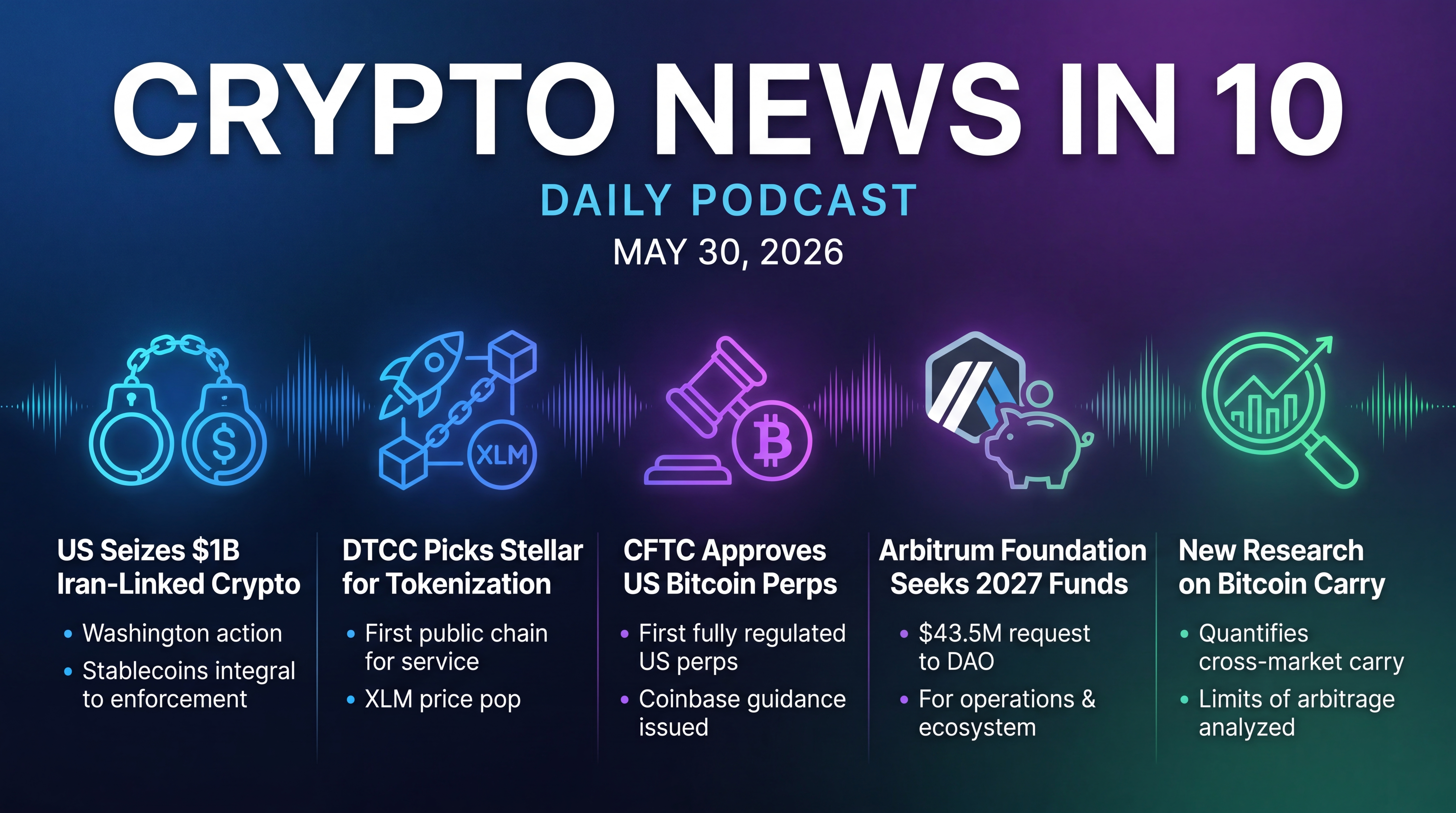
Episode Infographic
Show Notes
Welcome to our Crypto news in 10, a daily podcast bringing you the latest news about crypto in under 10 minutes.
Here's what's moving crypto today... Saturday, May 30, 2026.
We've got five big stories. Washington says it's seized roughly a billion dollars in Iran-linked crypto. Wall Street's post-trade giant DTCC chose Stellar as the first public chain for its tokenization service — and XLM popped. The CFTC approved the first fully regulated U.S. bitcoin perpetual and issued guidance that opens a compliant lane for American perps, with a companion no-action letter to Coinbase. Arbitrum's foundation returned to the DAO with a fresh funding request for 2027 operations. And a new research paper uses ETF files and put-call parity to quantify bitcoin's cross-market carry — and where arbitrage still breaks down.
Let's jump in.
[BEGINNING_SPONSORS]
First, policy and geopolitics. U.S. Treasury Secretary Scott Bessent says the government has seized about a billion dollars in cryptocurrency from Iranian networks since the war began... framing it as an escalation — the ability to grab the wallets. That claim follows Treasury's Operation Economic Fury actions earlier this month, which documented nearly half a billion dollars in crypto already frozen, along with broader sanctions on Iran's shadow banking and oil networks.
The takeaway for crypto is clear: stablecoins and centralized chokepoints are increasingly integral to sanctions enforcement — and yes, they can be frozen — while on-chain transparency continues to power investigations. Reporting came from Decrypt and The Block, with Treasury press releases providing the official detail.
Second, tokenization just got a very public vote of confidence. The Depository Trust and Clearing Corporation — DTCC — says it will connect its tokenization service to the Stellar public blockchain. DTCC processes more than 100 trillion dollars in securities annually. Now it's moving toward issuing and managing tokenized versions of assets it already custodies — large-cap equities, ETFs, Treasuries, and corporate bonds — on Stellar, with availability targeted for the first half of 2027.
Markets noticed... XLM rallied as the news landed, and coverage emphasized DTCC's multi-chain strategy and Stellar's compliance-minded design. Official details arrived in DTCC's May 27 statement, with additional context from CoinDesk.
Third, a watershed for U.S. derivatives. The CFTC approved Kalshi's BTCPERP — a bitcoin perpetual futures contract tied to the spot price — and separately issued guidance plus a no-action letter to Coinbase Financial Markets. In plain English, staff confirmed certain crypto perps can be treated as foreign futures, and the Coinbase letter explains how futures commission merchants may transfer customer crypto to foreign brokers as margin — critical plumbing if you want compliant access to 24/7 global markets.
The agency also put out an advisory on around-the-clock risk management and clearing. This is the first time U.S. perps are getting an onshore, rules-based path... expect others to follow with case-by-case review. Sources include CFTC releases and Axios for market context.
[MIDPOINT_SPONSORS]
Number four — governance and budgets. The Arbitrum Foundation posted a new request to the DAO for approximately 43.5 million dollars to fund 2027 operations — split across 16 million in cash and real-world assets, about 1,740 ETH, and 230 million ARB. The filing cites continued ecosystem growth and lays out how spending would cover core tech, security, and ecosystem programs, as Arbitrum works to align foundation costs with DAO revenue over time.
The proposal is live on Arbitrum's forum. Several outlets summarized the numbers and the debate around tying budget to measurable outcomes. Voting and feedback windows will determine the final shape — and size — of the package.
And fifth, research that matters for traders. A new paper — Implied ETF Carry Rates and the Limits of Arbitrage in Segmented Bitcoin Markets — uses put-call parity, ETF daily holdings files, CME futures pricing, and the BRRNY reference rate to back out an implied forward from spot ETFs, then compares it to futures-market carry. The punchline: even with spot ETFs, market segmentation and frictions can leave persistent basis differentials that aren't fully arbitraged away... useful insight if you're running cross-venue basis or hedged carry strategies.
The study hit arXiv on May 28 and adds data-driven heft to a topic many desks have been trading mostly by feel.
Quick extras before we wrap. On the Treasury and Iran story, separate reporting this spring documented Tether freezing hundreds of millions of dollars on Tron linked to illicit activity — another reminder that stablecoin policy is de facto financial policy. And on DTCC and Stellar, remember the timeline: the target is first-half 2027 availability, so this is infrastructure building — not instant volume.
That's it for today. Recap: Washington says about a billion dollars in Iran-linked crypto has been seized... DTCC's tokenization rail will connect to Stellar... the CFTC just opened a compliant path for U.S. crypto perps with Kalshi's bitcoin perpetual and a Coinbase no-action letter... Arbitrum's foundation is asking its DAO for a 43.5 million dollar 2027 budget... and new research quantifies ETF carry and arbitrage frictions across bitcoin markets.
See you tomorrow for the next ten in crypto.
Thanks for listening and see you tommorow!
