
Mastercard Lights Up Stablecoin Rails, Bitcoin Slips
Mastercard moves on-chain settlement from pilot to production, even as crypto markets rotate into stablecoins and Bitcoin tests the mid-sixties. We also cover OFAC's new Iran-related sanctions guidance, Robinhood's WonderFi close, and the UK's consultation deadline shaping a 2027 regime.
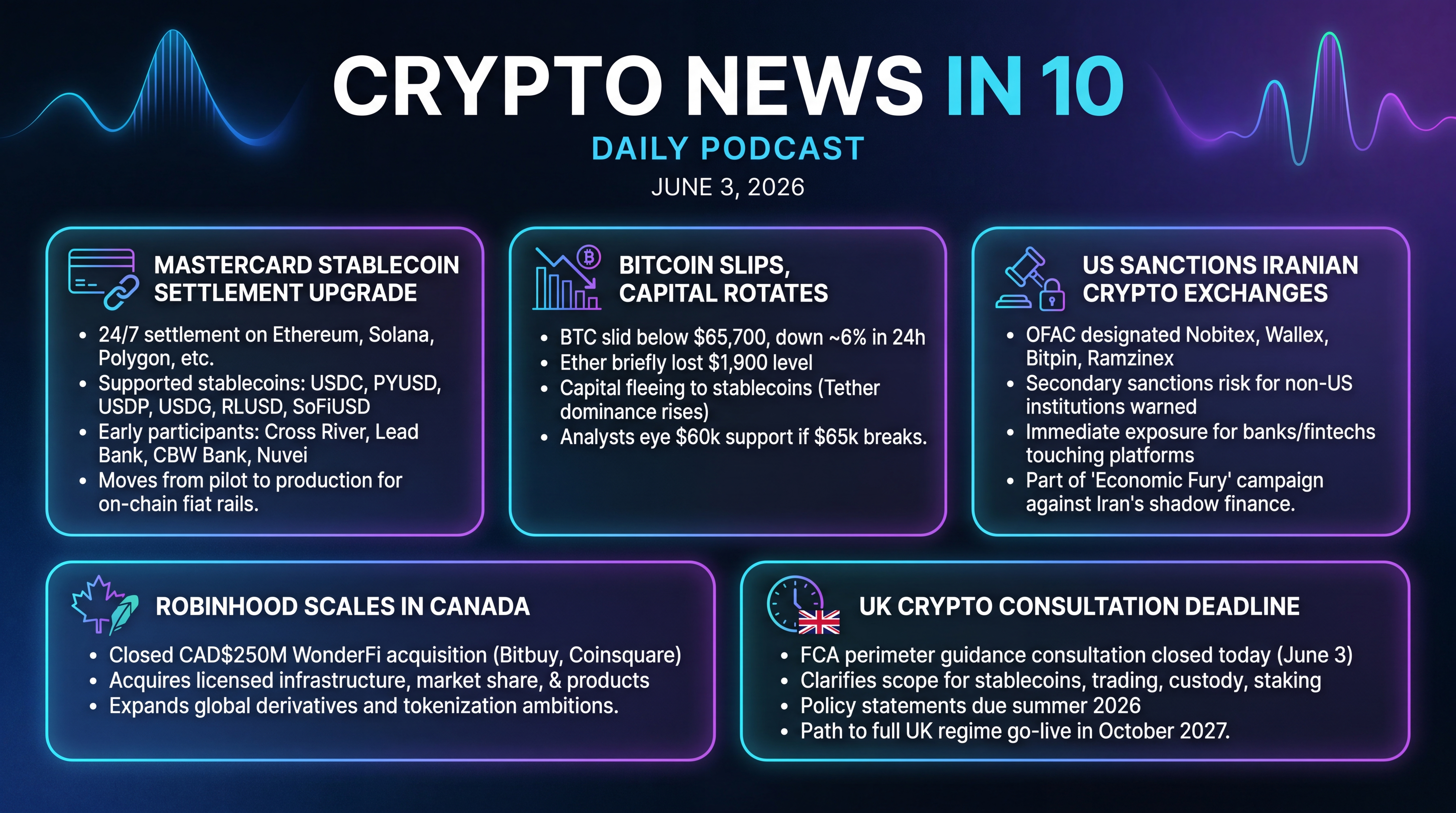
Episode Infographic
Show Notes
Welcome to our Crypto news in 10, a daily podcast bringing you the latest news about crypto in under 10 minutes.
Here's what's moving crypto on Wednesday, June 3, 2026. Mastercard is taking stablecoins mainstream with a big settlement upgrade... Bitcoin slipped below sixty-six thousand as traders hid out in digital dollars... the U.S. sanctioned four Iranian crypto exchanges — and warned even non-U.S. players they could be penalized... Robinhood officially closed its WonderFi acquisition to scale in Canada... and in London, the FCA's crypto consultation window closes today — an important waypoint toward a full UK regime in 2027. Let's unpack it.
[BEGINNING_SPONSORS]
Story one — Mastercard just signaled how real stablecoin settlement is getting. The company says issuers and acquirers will be able to settle card transactions on-chain using regulated dollar stablecoins — initially USDC and Paxos's PYUSD and USDP, plus USDG, Ripple's RLUSD, and SoFiUSD — alongside today's fiat rails.
Crucially, that means intraday, weekend, and holiday settlement across Ethereum, Solana, Polygon, Base, Arbitrum, and the XRP Ledger. Early participants include Cross River, Lead Bank, CBW Bank, ARQ, and Nuvei. As Mastercard's blockchain lead Raj Dhamodharan put it, the next phase is real-world utility where timing and liquidity matter most.
It's a plumbing story — but a big one. If stablecoins become a standard settlement asset, you shorten cutoff times, reduce counterparty risk windows, and potentially compress working capital needs for merchants and acquirers.
For context... in March, Mastercard agreed to acquire BVNK — an enterprise stablecoin infrastructure provider — for up to one point eight billion dollars. Since then, it has stacked partnerships that make on-chain settlement feel like an always-on option, not a pilot. Today's move looks like the switch from test to production.
Story two — prices. Bitcoin slid to an intraday low around sixty-five thousand seven hundred this morning, down roughly six percent in twenty-four hours and about twelve percent on the week. Ether briefly lost the nineteen hundred level.
Traders point to a mix of catalysts and tight risk management — but the standout data point is behavioral: the market is rotating into stablecoins. Bitcoin dominance has eased to about fifty-eight and a half percent, while Tether's share has climbed to multi-month highs — a classic flight to dollar liquidity, even as U.S. equities hover near records. In plain English... crypto-native cash is where people are hiding out.
Keep an eye on Bitcoin's sixty-five thousand line — breaks below there have technicians eyeing sixty thousand.
And yes, the broader context matters. Analysts continue to flag headline risk and a cautious tone after a run of market-moving events, but the fresh piece today is the new local low and that visible migration into stablecoins.
Story three — the U.S. just tightened the compliance screws on Iran-linked crypto activity. Treasury's Office of Foreign Assets Control — OFAC — designated Nobitex, by far Iran's largest exchange, along with Wallex, Bitpin, and Ramzinex, plus several executives. Here's the headline for compliance teams outside the U.S.: OFAC's new FAQ twelve fifty-seven says non-U.S. institutions can face secondary sanctions risk if they keep doing significant business with these exchanges.
This isn't a theoretical memo — it's immediate exposure for banks and fintechs servicing counterparties that touch these platforms. If your screening lists haven't been updated since yesterday... they're stale.
Policy-wise, the action sits inside Treasury's "Economic Fury" campaign targeting Iran's shadow finance — a track that has emphasized digital asset flows this spring. For crypto companies, the near-term impact is stricter counterparties and more KYC friction on cross-border flows touching the region.
[MIDPOINT_SPONSORS]
Story four — Robinhood is officially bigger in Canada's crypto market. The company closed its roughly two hundred fifty million Canadian dollar WonderFi acquisition on June first, rolling up regulated brands like Bitbuy and Coinsquare under the Robinhood umbrella. Management framed the deal as an entry point to deliver "trusted, innovative crypto offerings" to Canadians, and WonderFi confirmed the closing and delisting steps as part of the court-approved plan of arrangement.
Strategically, this gives Robinhood licensed infrastructure, local market share, and product breadth in a region that's become a fast-growing North American crypto hub. If you're tracking competitive angles... Robinhood already has global derivatives and tokenization ambitions, and this plugs in regulated exchanges and customers north of the border. It also dovetails with a wider twenty twenty-six push by U.S. platforms to diversify revenue beyond pure U.S. spot trading.
Story five — deadline day in the UK. The Financial Conduct Authority's consultation on perimeter guidance for the UK's future crypto regime closes today, June third. The paper clarifies which activities fall inside the upcoming rules — issuing qualifying stablecoins, operating trading platforms, dealing and arranging deals, custody, and staking — on the way to applications opening in September twenty twenty-six and the full regime going live in October twenty twenty-seven.
The FCA says policy statements land this summer, with decentralized finance — DeFi — specific guidance and operational resilience topics still to come. Translation: the UK is locking in scope now so firms can plan licensing and capital early.
Why it matters beyond London: global groups weighing Europe, the U.S., Hong Kong, and the Gulf are mapping products to jurisdictions with clear, bankable rules. A crisp UK perimeter helps treasury teams, stablecoin programs, and exchange operations that want predictability on what needs authorization — and when.
Quick recap. Mastercard's on-chain settlement expansion is the day's structural headline — bringing weekend and holiday settlement for a slate of regulated stablecoins across six major networks. Markets stayed skittish — Bitcoin tagged the mid-sixties as capital rotated into stablecoins. Washington tightened sanctions risk around Iran-linked exchanges, with explicit secondary exposure for non-U.S. institutions. Robinhood closed its WonderFi deal to scale in Canada. And in the UK, the FCA's crypto consultation window closes today, paving the road to a twenty twenty-seven go-live.
We'll be back tomorrow with the next round of moves... and hopefully, fewer red candles.
Thanks for listening and see you tommorow!
