
Volatility Futures, Tokenized IPOs, and MiCA Countdown
CME debuts bitcoin volatility futures while Bybit brings tokenized IPO access to retail with SpaceX in focus. Plus Zcash’s Ironwood plan, the EU’s MiCA crunch, and a market wrap after a half-billion-dollar short squeeze and gold’s slide.
Episode Infographic
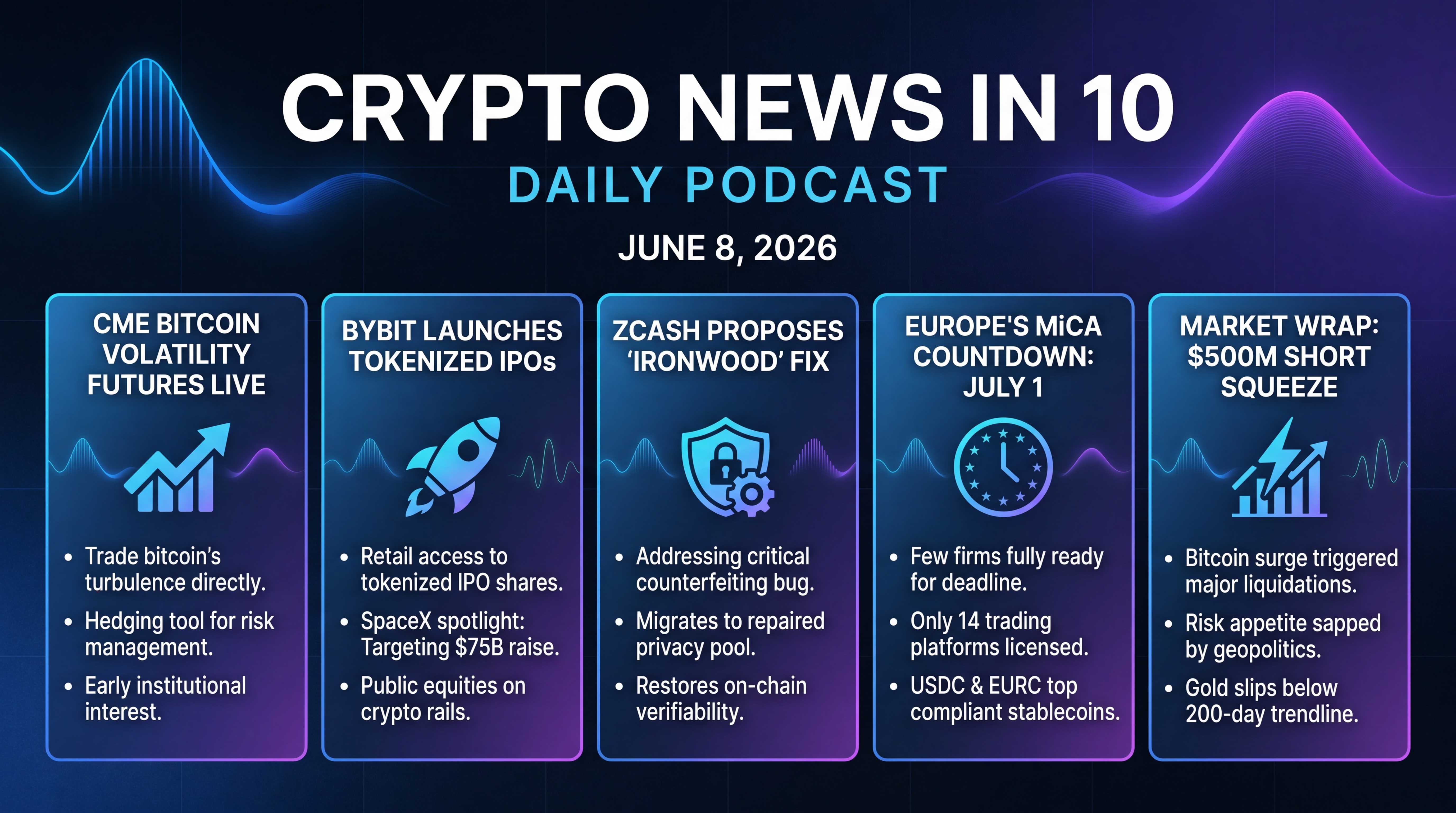
Show Notes
Welcome to our Crypto news in 10, a daily podcast bringing you the latest news about crypto in under 10 minutes.
Here’s your quick tour of today’s crypto headlines for Monday, June 8, 2026.
We’ve got a new way to trade bitcoin’s turbulence on CME... Bybit opening tokenized IPO access for retail — with SpaceX in the spotlight... Zcash developers proposing a major fix, and the token ripping higher... a reality check on Europe’s MiCA rulebook as the July 1 cutoff nears... and a market wrap where shorts got squeezed for half a billion dollars while gold quietly slipped below its 200-day trendline.
Let’s get into it.
[BEGINNING_SPONSORS]
Story one — CME just switched on a product that lets you trade bitcoin’s choppiness itself, without taking a view on price direction. The exchange has launched bitcoin volatility index futures tied to the CME CF Bitcoin Volatility Index — a gauge of expected four-week bitcoin swings.
Two firms — Monarq Asset Management and DV Chain — have already executed the first block trades, underscoring early institutional interest.
The pitch is simple: you can now go long or short volatility around macro events — think this week’s U.S. inflation print — while staying agnostic on whether bitcoin moves up or down. It also gives risk desks a regulated hedge against whipsaw markets. As CoinDesk notes, the contracts expand CME’s crypto suite and formalize a tool traders have long wanted onshore.
Why this matters — liquidity and hedging. When volatility becomes tradable in its own right, market makers and funds can manage risk more precisely — potentially dampening the extremes of forced liquidations we’ve seen in recent weeks... or, if positioning gets crowded, amplifying them in the other direction. Either way, it’s a milestone in crypto market structure.
Story two — tokenized IPOs are stepping into the mainstream. Bybit unveiled IPO Express, giving eligible retail investors the ability to subscribe to tokenized shares at official IPO pricing — starting with SpaceX this week.
Registration runs June 7 through June 11, allocations hit June 11, and spot trading of the token begins June 12. Bybit positions itself as the second crypto exchange after Kraken to offer tokenized IPO participation, differentiating from earlier pre-IPO derivatives that were closer to IOUs or prediction markets.
The headline number: SpaceX is targeting a 75 billion dollar raise at an estimated 1.75 trillion dollar valuation. As always, eligibility and jurisdictional rules apply — but the direction of travel is clear: public equities meeting crypto rails.
The takeaway: if tokenized access scales, IPO allocations — historically locked up by underwriting syndicates and private banking channels — could open to a far broader base. That’s a sea change in primary issuance mechanics, even if it starts outside the U.S. and with tight compliance gates.
Story three — Zcash’s big scare is meeting an equally big engineering response. After last week’s disclosure of a critical counterfeiting vulnerability in the Orchard shielded pool, core teams proposed the Ironwood upgrade.
Ironwood would migrate users to a repaired privacy pool and, crucially, allow anyone running Zcash software to verify that no more than the correct amount of ZEC exists — restoring supply integrity checks at the protocol level.
Markets liked the clarity: ZEC has bounced roughly 45% off Friday’s lows... though it’s still down week over week as the community assesses timelines and testing. Developers say any counterfeit coins would be revealed or stranded during migration, and exploitation is viewed as unlikely.
At a deeper level, this is about trust minimization — moving from "trust the devs" back to "verify with software." It also shows how fast coordinated client, miner, and foundation actions can move when a privacy chain hits a systemic bug.
[MIDPOINT_SPONSORS]
Story four — Europe’s MiCA crunch is three weeks away. A new roundup highlights how few firms are fully ready for July 1, when the transitional period ends.
Across the EU, 183 entities have secured some form of authorization — but only 14 reportedly hold the license to operate trading platforms under MiCA. The report also flags that USDT isn’t listed on MiCA-licensed venues, leaving USDC and EURC as the top compliant stablecoins for EU platforms.
For users in countries with zero authorizations so far — like Poland, Italy, and Romania — the guidance is simple: make sure your provider is on the authorized list, or move before the deadline. It’s a stark picture of how demanding the final rulebook is for exchanges versus custodians or brokers.
Zooming out, this is the most consequential compliance line in the sand since Europe began writing digital-asset rules. It will likely consolidate market share toward a handful of passported platforms and standardize disclosures, custody, and market-abuse controls across the bloc. If you custody or trade in the EU, check your venue’s status now.
Story five — a market wrap with some whiplash. Over the weekend and into Monday, bitcoin ripped to about 63,700 dollars, triggering roughly 504 million dollars in short liquidations — the biggest daily squeeze since late April — before easing back near 63,000 as renewed Iran-Israel strikes and a sharp selloff in Korean equities sapped risk appetite.
Total liquidations across crypto topped 650 million dollars over 24 hours. Meanwhile, derivatives positioning shows futures open interest falling from last week’s peaks — evidence the selloff flushed leverage — while options flow tilted toward out-of-the-money calls as implied volatility cooled from Friday’s spike.
Two macro footnotes worth noting. First, gold slipped below its 200-day moving average and is down more than 20% from its January record — an unusual backdrop that, paradoxically, nudged the bitcoin-to-gold ratio higher on the day. Second, Asia’s risk tone was fragile — South Korea’s KOSPI fell nearly 7% — as oil firmed on geopolitical tension.
All of that feeds into this week’s U.S. inflation data and keeps the "volatility" in crypto volatility very real... which loops us back to CME’s new hedging tool from story one.
That’s a wrap. Today... CME’s volatility futures give pros a new on-ramp to hedge or express views... Bybit’s tokenized IPOs push primary markets on-chain... Zcash’s Ironwood plan restores verifiability... Europe’s MiCA clock is ticking with just 14 trading platforms licensed... and markets squeezed shorts before handing the baton back to macro.
Stay nimble, manage your risk — and we’ll see you tomorrow.
Thanks for listening and see you tommorow!
